
The short version
The Chupacabra, Spanish for “goat sucker”, was first reported in Puerto Rico in 1995, when dead goats said to have been drained of blood began to turn up. Witnesses described a small, upright creature with spikes down its back, and reports later spread to Mexico, the southern United States and much of Latin America. From the early 2000s a different “Chupacabra” took over: a hairless, dog-like animal, several of which were shot or found dead in Texas. DNA tests on those animals pointed to coyotes and dogs, and biologists say severe mange explains their strange look. Sceptics also trace the original 1995 description to a science-fiction film. Believers say that new animals are still being discovered and that the first wave of reports has never been fully explained.
The forerunner: the Vampire of Moca
Twenty years before the Chupacabra, in February 1975, dead cows, goats and pigs with puncture wounds in their necks began to appear around Moca, a town in Puerto Rico. The tabloid El Vocero called the killer the “Vampire of Moca”. By 27 March there were more than 100 dead animals. Two government veterinarians concluded that the animals had been shot with pellets, while the police suggested a pronged fishing spear. El Vocero never reported anything conclusive, and the case was never solved. Believers cite it as evidence that the creature existed before 1995.
Puerto Rico, 1995
The new wave began in March 1995 with reports of dead livestock in the towns of Orocovis and Morovis. The radio comedian Silverio Pérez is generally believed to have been the first to call the killer a “chupacabras”. National Geographic puts the number of reports from Puerto Rico that year at more than 200.
The image that defined the creature came in August 1995. Madelyne Tolentino said that she and her mother had seen it in front of their house in Canóvanas, and a sketch based on her account ran in a Puerto Rican newspaper. Accounts of her description differ, but it was a small, upright creature with spikes down its back, long thin limbs and an oblong head. The mayor of Canóvanas vowed to protect the public, and the story was taken up by the popular Spanish-language talk show El Show de Cristina.
The film connection
The investigator Benjamin Radford, then managing editor of the magazine Skeptical Inquirer, spent years on the case and published Tracking the Chupacabra in 2011. He noticed that Tolentino’s creature closely resembled the alien-human hybrid in the film Species, which opened in Puerto Rican cinemas in July 1995, weeks before her sighting, and Tolentino had seen it in the weeks before she made her description. “The question then becomes which is more likely,” Radford told Live Science, “the astronomical chance that this creature looks exactly like the one from ‘Species,’ or that the film is just where she got the depiction?”
Loren Coleman, director of the International Cryptozoology Museum in Portland, Maine, and a cryptozoologist rather than a sceptic, also pointed to the film, noting that its opening in Puerto Rico overlapped with the first explosion of reports.
The Texas Chupacabras
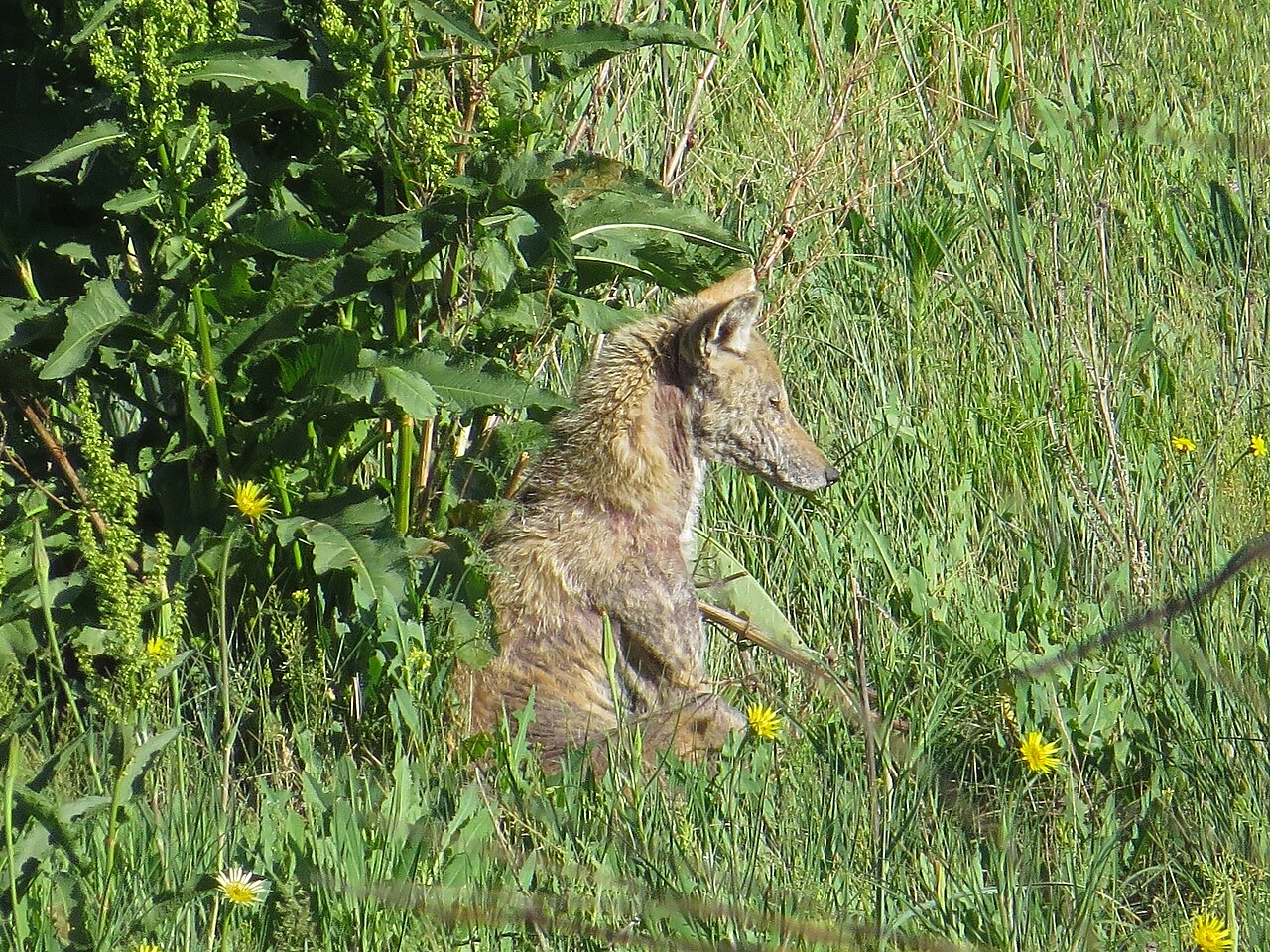
By 2000 the spiky creature had largely been replaced in popular accounts by a dog-like one. In 2004 something began attacking livestock in Texas, and a farmer near Elmendorf, close to San Antonio, shot a hairless animal. A cryptozoology writer later reported that DNA tests found it was a feral dog. In July 2007 a rancher in Cuero, 90 miles south-east of San Antonio, found three hairless carcasses. Biologists at Texas State University said the DNA was “a virtually identical match” to that of a coyote. In 2008 a sheriff’s deputy in the same area filmed another supposed Chupacabra.
Biologists explain the look with sarcoptic mange, caused by the mite Sarcoptes scabiei, the same mite that causes scabies in people. It thickens the skin and makes the fur fall out, leaving a naked, leathery, often smelly animal. John Tomeček of Texas A&M AgriLife says the last fur a coyote loses is the ridge between its shoulder blades, which can look like spikes. A wildlife disease specialist told National Geographic that such an animal “still looks like a coyote, just a really sorry excuse for a coyote”.


The arguments, point by point
The drained blood
Those who believe it say: the victims are found with puncture wounds in their necks and no blood, which no ordinary predator leaves behind.
The response: Radford says that when supposed victims have been examined, they “invariably” contain plenty of blood. Dogs and coyotes go for the neck, and their canine teeth leave puncture wounds. Tomeček notes that coyotes have to bite repeatedly to keep a grip, and that after death blood settles and clots, so a carcass can look drained. A sick coyote that cannot hunt wild prey may turn to penned animals.
An unknown animal
Those who believe it say: not every animal has been classified, and the creature could be a new species, an escaped laboratory experiment or something from outer space. Believers point to a primate research centre in Puerto Rico, and Coleman has raised the idea of escaped rhesus monkeys. “We know that new animals are being discovered all the time,” he told National Geographic.
The response: every Chupacabra carcass that has been tested turned out to be a known animal, usually a dog or a coyote. Radford adds that by the mid-2000s almost anything strange was being called a Chupacabra, including dead raccoons and a dried fish.
The original creature
Those who believe it say: mange may explain the Texas animals, but not the upright, spiky creature described in Puerto Rico. Even Coleman says the mange explanation “doesn’t mean it explains the whole legend”.
The response: sceptics say the Puerto Rican description came from Species, not from an animal. They also note that Tolentino’s sighting was far from the reported livestock deaths, and that her creature attacked nothing.
What is still argued about
- What killed the animals in Moca in 1975 and in Puerto Rico in 1995. Neither wave was officially solved.
- Whether anything lies behind the original description besides a film.
The legend is still alive. In October 2026 the Mexican ufologist Jaime Maussan released footage of a pale, hairless animal near Ciudad Juárez that he said was taking hens and rabbits. Online commentators compared it to the Chupacabra. Local civil protection officials and the El Paso County sheriff’s office said they had received no reports, and no carcass or DNA sample has been made public. In a YouGov poll of Americans in November 2025, 16% said the Chupacabra definitely or probably exists.
Sources
- Live Science, “El Chupacabra Mystery Solved: Case of Mistaken Identity” (2011)
- McGill Office for Science and Society, Jonathan Jarry, “The Mythical Creature Known as the Chupacabra Walked Out of a Movie” (2023)
- Skeptoid, “On the Trail of the Chupacabra” (2022)
- Radio Ambulante, “A Vampire Among Us” (2026)
- National Geographic, “The chupacabra—how evolution made a mythical monster” (2010, updated 2025)
- NBC News / AP, “Mythical, bloodsucking beast just a coyote” (2007)
- Scientific American, “Chupacabra strikes Texas town?” (2008)
- San Antonio Current, “Beware the Elmendorf Beast!” (2011)
- ScienceDaily / University of Michigan, “Scary chupacabras monster is as much victim as villain” (2010)
- Texas A&M AgriLife Today, “From spooky lore to science fact: Unmasking the ‘chupacabra’” (2024)
- Live Science, Benjamin Radford, “‘Chupacabra’ Kills Sheep in Mexico. Why False Reports Persist” (2012)
- ABC News, “Texas’ Blood-Sucking Monster” (2006)
- IBTimes UK, “Mexico’s Mysterious Hairless Beast Reportedly Snatches Farm Animals as ‘Chupacabra’ Fears Resurface” (2026)
- YouGov, “Half of Americans believe aliens have visited Earth” (2025)