
The short version
’Oumuamua was the first object ever seen passing through our Solar System from somewhere else. It was already on its way out when it was found, and what telescopes recorded did not fit neatly with any known comet or asteroid. Harvard astronomer Avi Loeb proposed that it could be a piece of alien technology, such as a thin sail pushed by sunlight. A review by 14 astronomers concluded that the observations are consistent with a natural origin, though researchers have not agreed on which one. The object is now far out of reach and cannot be observed again.
What was seen
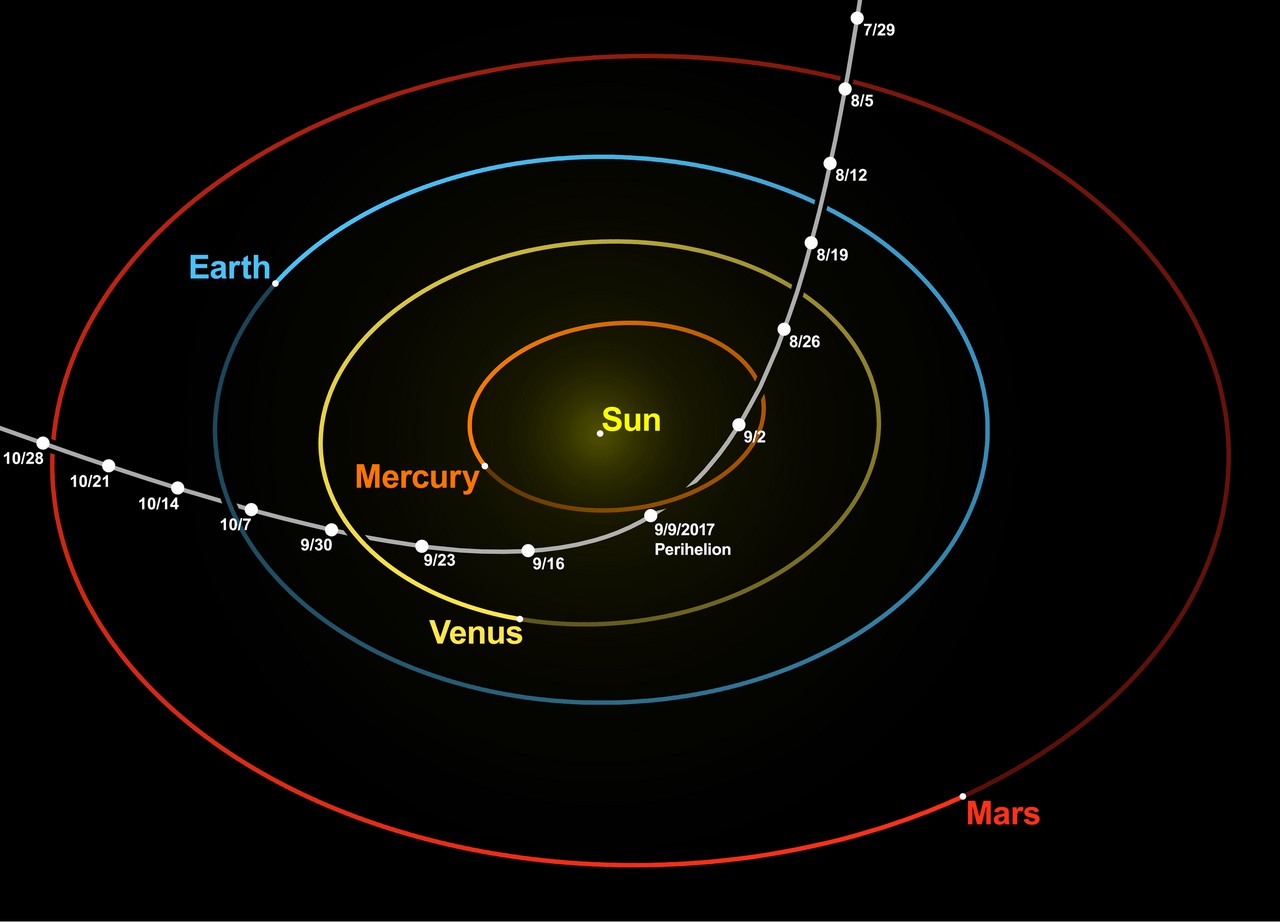
Discovery. On 19 October 2017, Rob Weryk, a researcher at the University of Hawaii, spotted a moving point of light in images from the Pan-STARRS 1 telescope on Haleakala. Its path was too fast and too open to be an orbit around the Sun. “This object came from outside our solar system,” Weryk said. A NASA orbit specialist called it the most extreme orbit he had ever seen.
Already leaving. By then it had passed its closest point to the Sun, on 9 September, at 87.3 kilometres per second. It had passed the Earth on 14 October at about 24 million kilometres, roughly 60 times the distance to the Moon.
The name. Hawaiian-language experts helped choose the name, which NASA translates as “a messenger from afar arriving first”. Its formal designation is 1I/2017 U1.
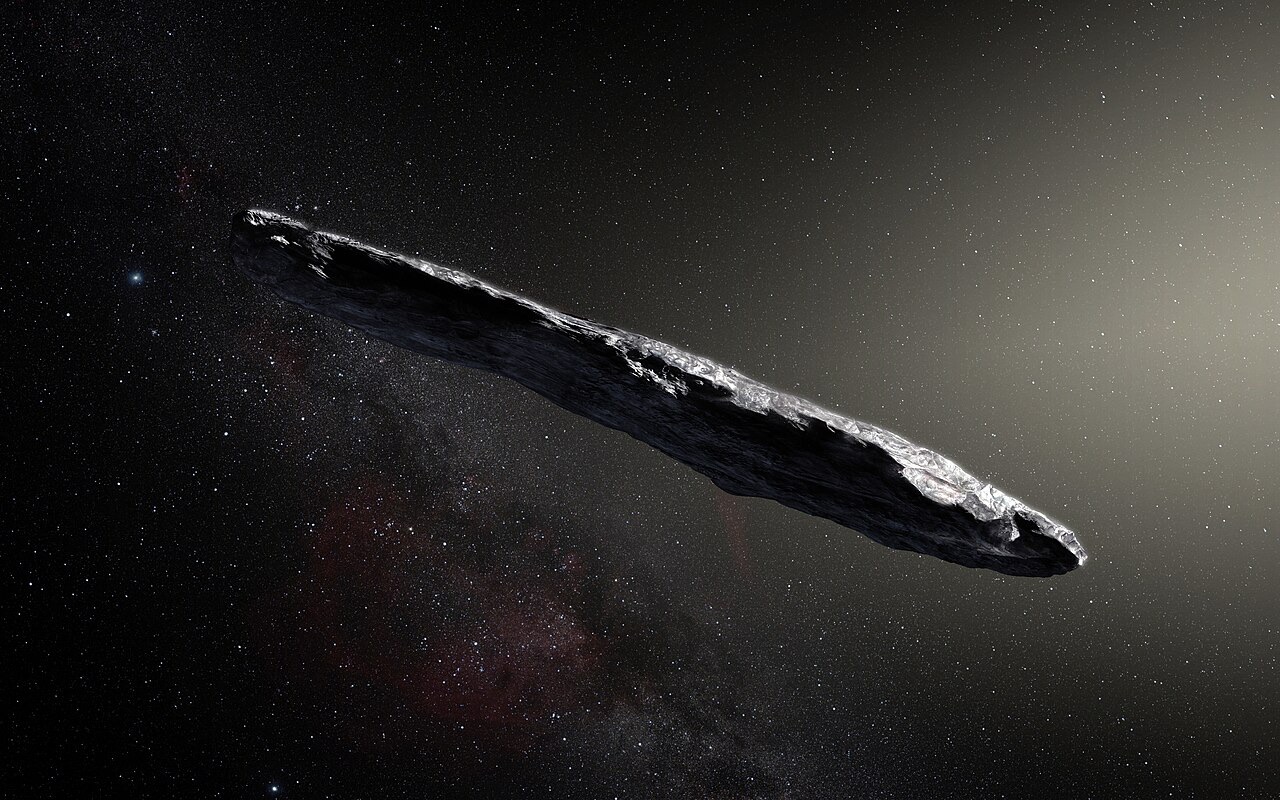
The shape. Its brightness rose and fell by a factor of ten roughly every seven hours, which means it was tumbling and far from round. Early estimates described a dark red object about 400 metres long and ten times longer than wide, like a cigar. Later modelling found that a flat disc fits the data about as well. A space telescope that looked for its heat saw nothing, which suggests it was smaller and shinier than first thought.
No tail. It was first labelled a comet and then reclassified as an asteroid. No telescope saw a cloud of gas or dust around it.
The push. In June 2018 a team led by Marco Micheli reported in Nature that ’Oumuamua was accelerating slightly in a way that gravity alone does not explain. Comets do this when sunlight boils gas off their surface and the escaping gas acts like a small rocket. The team called this the likely cause. The difficulty was that no gas had been seen.
The alien technology hypothesis
In November 2018, Shmuel Bialy and Avi Loeb published a paper asking whether the push could come from sunlight itself. They calculated that it could, if the object were a sheet less than a millimetre thick. One possibility, they wrote, “is that ’Oumuamua is a lightsail, floating in interstellar space as debris from advanced technological equipment”. A “more exotic scenario” was a working probe sent on purpose. The same paper allowed that such a thin object might form naturally by an unknown process.
Loeb developed the case in his 2021 book Extraterrestrial: The First Sign of Intelligent Life Beyond Earth. His main points:
- The shape is unusually extreme.
- The object appeared to be at least ten times more reflective than typical Solar System rocks.
- It accelerated with no visible gas or dust, which a sail pushed by sunlight would explain.
The response
Listening. In late 2017 two teams pointed radio telescopes at ’Oumuamua: the SETI Institute with the Allen Telescope Array in California, and Breakthrough Listen with the Green Bank Telescope in West Virginia. Neither detected a signal. The SETI Institute team said its search could not conclusively rule out a non-natural origin, but would have picked up a transmitter with a power of less than one watt.
The review. In July 2019 a team of 14 astronomers published a review of everything known in Nature Astronomy. They wrote that “in all cases, the observations are consistent with a purely natural origin” and that they found “no compelling evidence to favor an alien explanation”. One of the team’s leaders, Matthew Knight, added: “We have never seen anything like ’Oumuamua in our solar system. It’s really a mystery still.”
The natural candidates. Each explanation below has been published in a scientific journal or as a research paper.
- A hydrogen iceberg (2020). A lump of frozen hydrogen would give off gas that telescopes could not see. Loeb and a colleague replied that such ice would not survive the journey between stars.
- A chip of nitrogen ice (2021). A fragment knocked off a Pluto-like planet in another system, worn flat by the Sun. Loeb and a colleague replied that there is not enough of that material in the galaxy to make such fragments common.
- A fluffy clump of dust, light enough for sunlight to push. It would need to be extraordinarily porous.
- A shard of a larger body torn apart when it passed close to its star (2020).
- Trapped hydrogen in water ice (2023). Jennifer Bergner and Darryl Seligman argued in Nature that cosmic rays had made hydrogen inside an ordinary icy body over its long journey, and that warmth from the Sun released it. Their paper said earlier models had inconsistencies or needed finely tuned conditions. Loeb and a colleague replied within days that the calculation left out a cooling effect. The authors answered that this was unlikely to change their conclusion.
What came next
Two more visitors. A second interstellar object, 2I/Borisov, was found in 2019 and was a comet, with a cloud of gas and dust. A third, 3I/ATLAS, was reported on 1 July 2025. Loeb and two co-authors posted a paper asking whether it too could be technological, which they described as largely a teaching exercise. NASA said in November 2025: “This object is a comet.” Radio searches of 3I/ATLAS in late 2025 and 2026 found no artificial signals.
The sea-bed expedition. In 2021 Loeb launched the Galileo Project to look for physical evidence of extraterrestrial technology. In June 2023 he led an expedition that dragged a magnetic sled across the Pacific sea floor near Papua New Guinea, where a meteor he believes came from another star fell in 2014. The team recovered about 700 tiny metal spheres and reported that some had an unusual composition. Other scientists replied that such spheres cannot be tied to one meteor, that their chemistry points to an origin in our own Solar System, and that a signal used to locate the fall came from a passing truck. Loeb disputes the truck finding.
Chasing it. Project Lyra, a study by the Initiative for Interstellar Studies, has shown on paper that a spacecraft launched around 2030 could catch up with ’Oumuamua, after a flight of 30 to 40 years.

What is still argued about
- What caused the extra push. No single natural explanation has been accepted by everyone in the field.
- What shape it was, and how big.
- Whether ’Oumuamua was a typical interstellar object or an unusual one. The Vera C. Rubin Observatory began a ten-year survey of the sky in 2026, and astronomers expect it to find more visitors. As Knight put it in 2019: “That’s when we’ll start to know whether ’Oumuamua is weird, or common.”
Sources
- NASA Jet Propulsion Laboratory, “Small Asteroid or Comet ‘Visits’ from Beyond the Solar System” (2017)
- NASA, “Solar System’s First Interstellar Visitor Dazzles Scientists” (2017)
- European Southern Observatory, “ESO Observations Show First Interstellar Asteroid is Like Nothing Seen Before” (2017)
- Micheli and others, “Non-gravitational acceleration in the trajectory of 1I/2017 U1 (’Oumuamua)”, Nature (2018)
- Bialy and Loeb, “Could Solar Radiation Pressure Explain ’Oumuamua’s Peculiar Acceleration?”, The Astrophysical Journal Letters (2018)
- Scientific American, “Astronomer Avi Loeb Says Aliens Have Visited, and He’s Not Kidding” (2021)
- The ’Oumuamua ISSI Team, “The natural history of ’Oumuamua”, Nature Astronomy (2019)
- The ’Oumuamua ISSI Team, “The Natural History of ’Oumuamua”, preprint with full text (2019)
- University of Maryland, “’Oumuamua is Not an Alien Spacecraft” (2019)
- Space.com, “’Oumuamua Stays Quiet: Another SETI Search of Interstellar Visitor Comes Up Empty” (2018)
- Bergner and Seligman, “Acceleration of 1I/’Oumuamua from radiolytically produced H2 in H2O ice”, Nature (2023)
- Salon, “A new paper says ’Oumuamua was a comet, not an alien spacecraft. Not everyone agrees” (2023)
- NASA Science, “Comet 3I/ATLAS”
- Live Science, “‘3I/ATLAS is a comet’: NASA finally releases new 3I/ATLAS images and addresses alien rumors” (2025)
- Scientific American, “‘Interstellar’ Meteor Signal May Have Been a Truck” (2024)
- Space.com, “Interstellar meteor fragments found? Astronomer’s claim sparks debate” (2023)
- Initiative for Interstellar Studies, “Project Lyra - Exploring Interstellar Objects”
- Adam Hibberd, Project Lyra mission study (2023)