
The short version
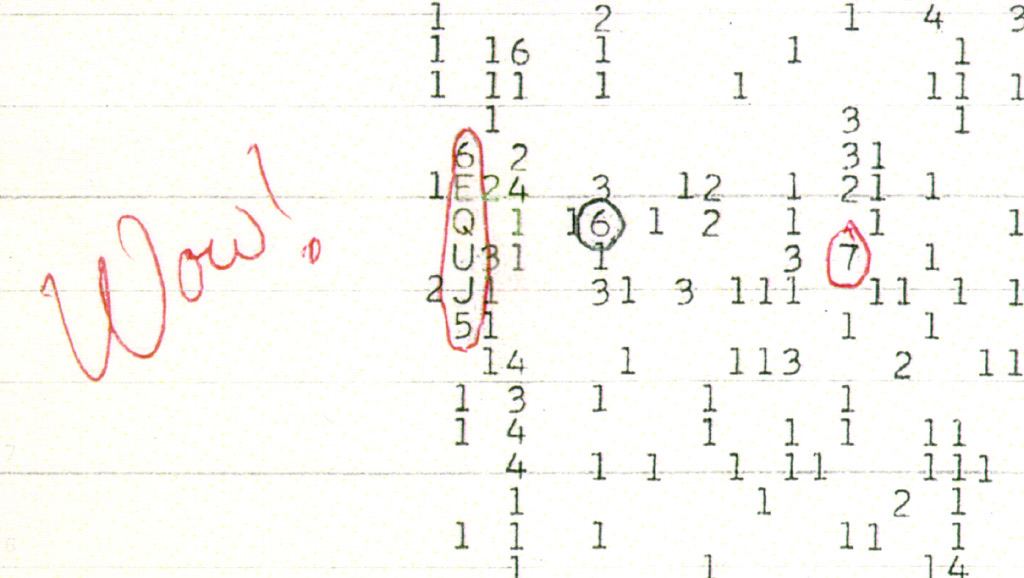
Late on 15 August 1977, the Ohio State University radio telescope known as Big Ear logged a strong burst of radio waves. A volunteer who checked the printout a few days later circled it in red and wrote “Wow!” in the margin. The signal had the features that searchers for alien life had said to look for. It also appeared once and never again, in more than a hundred later attempts. Nobody has shown what it was. In recent years one research team has argued for a rare natural flare, and its own leader says the case is not closed.
What was recorded
The telescope. Big Ear stood near Delaware, Ohio, and was the size of three football fields. It did not move. The turning of the Earth swept its view across the sky. From 1973 it ran a full-time search for signals from other civilisations.
The printout. Nobody was watching when the signal arrived. The computer printed the strength of what it heard as a row of characters, using the digits 1 to 9 and then the letters A to Z for stronger readings. The famous sequence “6EQUJ5” is six readings in a row, each covering about twelve seconds. It is a record of loudness, not a message. At its peak, the letter U, the signal was about 30 times stronger than the background noise.
The discovery. Jerry Ehman, a former Ohio State assistant professor working as a volunteer, found it a few days later during a routine check of the printouts.
Seventy-two seconds. That is how long any point in the sky took to drift through the telescope’s view. The signal rose and fell exactly as a fixed point among the stars would. So it lasted at least 72 seconds. How long it really lasted is unknown.
Why it caught attention
The frequency. The signal was close to 1420 megahertz, the natural radio frequency of hydrogen, the most common element in the universe. In 1959 the physicists Giuseppe Cocconi and Philip Morrison had argued in Nature that this was the obvious channel for one civilisation to hail another, a “unique, objective standard of frequency, which must be known to every observer in the universe”. The band is protected by international agreement, and no transmitter on Earth or in orbit is supposed to use it.
The narrowness. The signal showed up in only one of the receiver’s 50 channels. Natural radio sources usually spread across many.
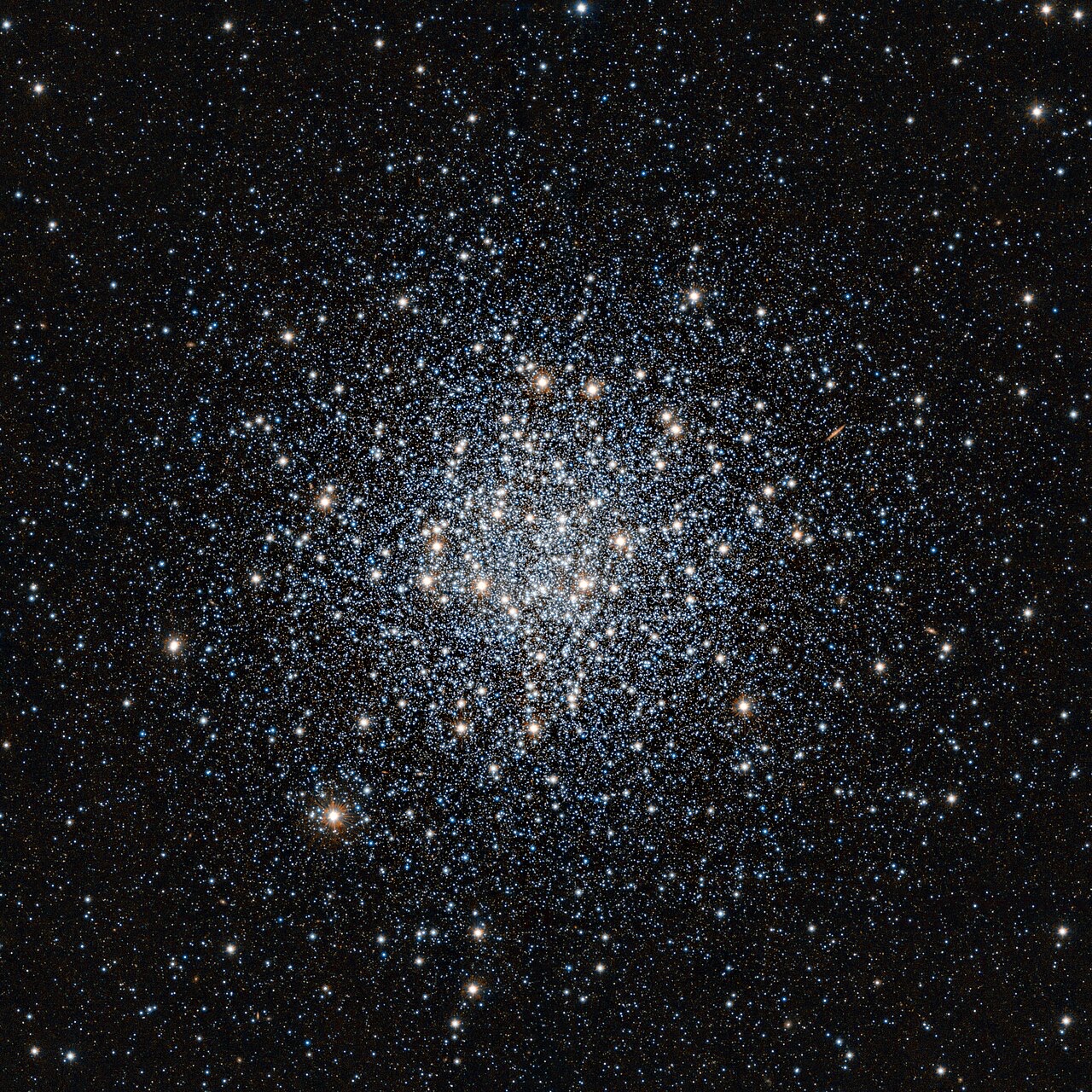
The direction. It came from the constellation Sagittarius, near the star cluster M55.
Why it is hard to explain
Big Ear listened through two receiving horns side by side, which swept the same patch of sky about three minutes apart. A steady source should have been recorded twice. The Wow! signal was recorded once. Either it switched off within three minutes, or it switched on. The records do not show which horn caught it, so there are two possible positions for the source.
Big Ear looked again many times over the following weeks and years. Robert Gray, an independent researcher, searched for decades, with a dish in his back yard, with a Harvard telescope, with the Very Large Array in New Mexico, which was more than a hundred times as sensitive, and with a telescope in Tasmania that watched the spot for up to fourteen hours at a stretch. Nothing was found.
The arguments, point by point
The case for an artificial signal
- It was narrow, strong and next to the hydrogen line, as predicted eighteen years earlier.
- It behaved like a source fixed among the stars, not like an aircraft or a nearby transmitter.
- It turned on or off within minutes. Bob Dixon, who ran the search, said that pointed to an intelligent source more than a natural one.
- In 2020 the amateur astronomer Alberto Caballero searched a star catalogue for Sun-like stars in the two possible regions and found one close match, about 1,800 light-years away.
- A 2022 study found that the follow-up searches so far cannot rule out a source that repeats at random intervals. Its authors called the signal “arguably the most compelling” candidate ever found.
The case against
- It never repeated. Ehman himself has said there is too little data to draw conclusions. “I choose not to draw vast conclusions from ‘half-vast’ data,” he wrote.
- The receiver averaged everything over ten seconds, so if the signal carried any information, none was recorded.
- When two large radio telescopes were pointed at Caballero’s star in 2022, they heard nothing. Caballero himself has said a natural event is the most likely cause.
- One-off signals that cannot be fully explained are common in radio astronomy.

The proposed explanations
A reflection from Earth. In 1994 Ehman leaned towards a signal from Earth bouncing off a piece of space debris. He later gave this “a low probability”. A transmitter would have had to be using the protected band, and the debris would have had to hang almost motionless against the stars. Seth Shostak of the SETI Institute still suspects interference of human origin.
Comets. In 2016 Antonio Paris proposed that hydrogen clouds around two comets, undiscovered in 1977, were in the right area. Ehman and Dixon rejected the idea. Other astronomers said comets are not known to give off detectable signals at this frequency and that a comet would not vanish from one horn to the next. Paris conceded that he could not explain the horn problem.
A flaring hydrogen cloud. In 2024 a team led by Abel Méndez of the University of Puerto Rico reported finding similar but far weaker signals in old data from the Arecibo telescope, coming from cold clouds of hydrogen. They proposed that the Wow! signal was such a cloud suddenly brightening when struck by a burst of radiation from a dense, magnetic star. Outside scientists were cautious, since no flare of that kind has been observed. One said the idea had promise but few details. Another said it seemed contrived to him.
In 2025 the same team re-examined more than 75,000 pages of Big Ear printouts that former volunteers had kept. They concluded that the signal was stronger than had been thought and at a slightly different frequency, and found no sign of interference from satellites or from Earth. They favour a natural source in our galaxy. Both papers were posted as preprints. Méndez said the results do not solve the mystery.
What is still argued about
- What it was. A 2026 paper co-written by Méndez and Dixon said that “the exact nature of the Wow! Signal remains a mystery”.
- Which of the two positions in the sky it came from.
- Whether it will ever be possible to tell, without a second detection.
Big Ear was demolished in 1998 to make way for housing and a golf course. In 2012, on the signal’s 35th anniversary, a television channel and the Arecibo Observatory beamed a reply into space containing more than 10,000 Twitter messages.
Sources
- Jerry R. Ehman, “The Big Ear Wow! Signal (30th Anniversary Report)” (2007)
- Jerry R. Ehman, “The Big Ear Wow! Signal: What We Know and Don’t Know About It After 20 Years” (1997)
- Cocconi and Morrison, “Searching for Interstellar Communications”, Nature (1959), reprint
- The Delaware Gazette, “Last remains of Big Ear telescope removed” (1998), reproduced by the observatory
- The Planetary Society, “One Man’s Quest for SETI’s Most Promising Signal” (2012)
- Gray and Marvel, “A VLA Search for the Ohio State ‘Wow’”, The Astrophysical Journal (2001)
- Kipping and Gray, “Could the ‘Wow’ signal have originated from a stochastic repeating beacon?” (2022)
- Space.com, “Famous ‘alien’ Wow! signal may have come from distant, sunlike star” (2022)
- Berkeley SETI Research Center, “Breakthrough Listen Search for the WOW! Signal” (2022)
- Space.com, “Comet Likely Didn’t Cause Bizarre ‘Wow!’ Signal (But Aliens Might Have)” (2017)
- Astronomy Now, “Comet claim for mysterious Wow signal sparks controversy” (2017)
- Méndez and others, “Arecibo Wow! I: An Astrophysical Explanation for the Wow! Signal” (2024)
- Scientific American, “The Wow! Signal Might Not Have Been Aliens - But a Weird Cosmic Outburst” (2024)
- Méndez and others, “Arecibo Wow! II: Revised Properties of the Wow! Signal from Archival Ohio SETI Data” (2025)
- Space.com, report on the 2025 re-analysis
- Méndez, Dixon and Childers, “The Ohio SETI Program - The Last Decades” (2026)
- National Geographic, “Was the ‘Wow!’ signal a message from aliens?” (2026)
- SETI Institute, “Happy Birthday WOW!” (2017)
- Space.com, “Humanity Responds to ‘Alien’ Wow Signal, 35 Years Later” (2012)
- Paris and Davies, “Hydrogen Clouds from Comets 266P Christensen and P2008 Y2 (Gibbs) are Candidates for the Source of the 1977 WOW! Signal” (2015)
- Cleveland Plain Dealer, “The ‘Wow!’ Signal” (1994), reproduced by the observatory
- BBC Sky at Night Magazine, “The Wow! signal: a message from an extra-terrestrial civilisation?” (2025)
- Gray and Ellingsen, “A Search for Periodic Emissions at the Wow Locale”, The Astrophysical Journal (2002)
- Alberto Caballero, “An approximation to determine the source of the WOW! Signal” (2020)