
The short version
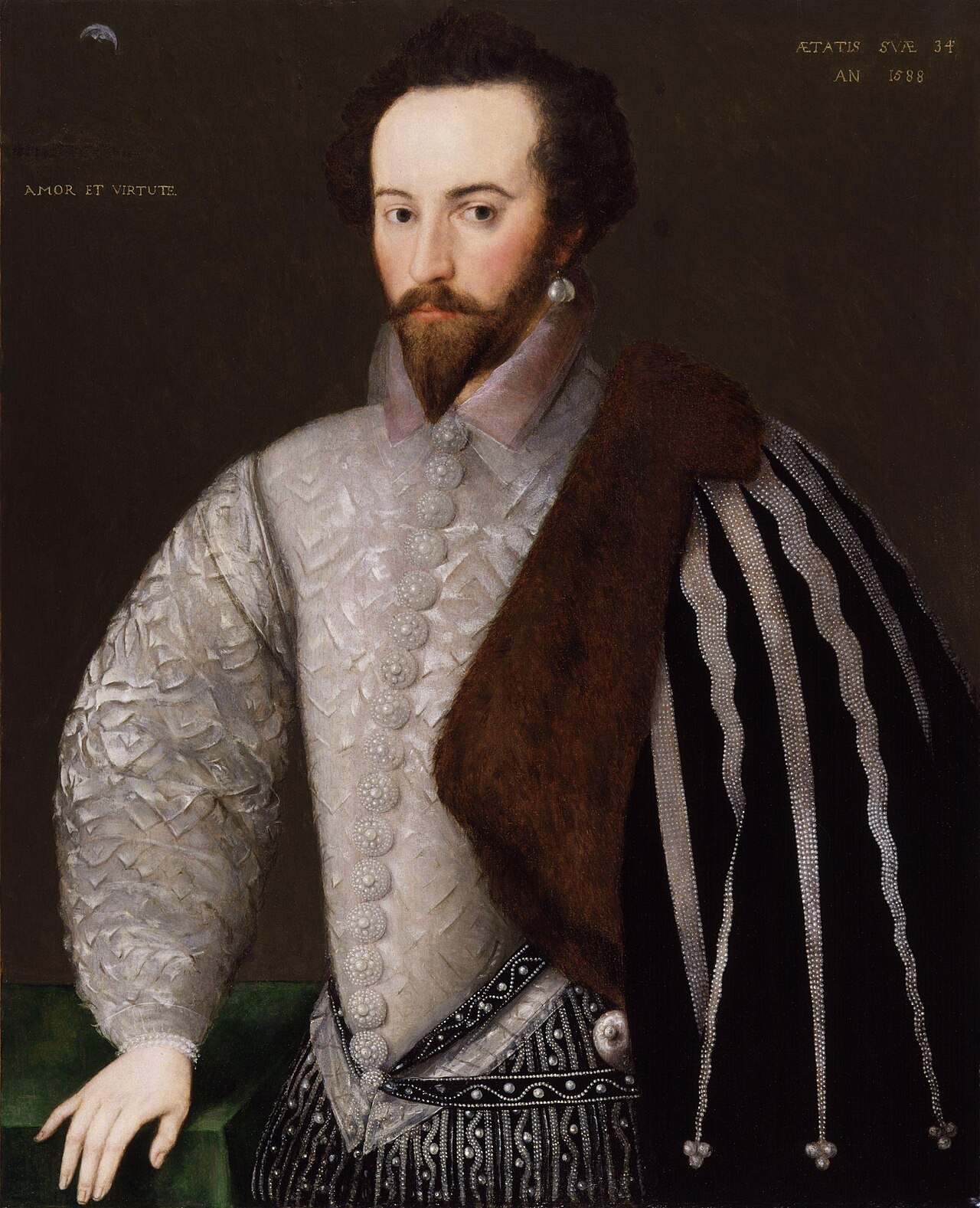
In 1587 an English expedition sponsored by Sir Walter Ralegh landed about 115 colonists on Roanoke Island, off the coast of what is now North Carolina. Their governor, the artist John White, sailed back to England for supplies, but war with Spain kept him away for three years. When he finally returned in August 1590, the settlement was empty. The houses had been taken down, and the word CROATOAN was carved on a post. White believed the colonists had gone to Croatoan, the island home of friendly Native allies. He never found them, and the fate of the “Lost Colony” has been argued over ever since. Today, two rival archaeological teams each believe they have found where the colonists went, and other experts say neither has proved it.
The colony
In 1584 Queen Elizabeth I granted Walter Ralegh a charter to settle lands not held by any Christian ruler. A reconnaissance voyage that year was followed in 1585 by an all-male military outpost under Ralph Lane, with John White as expedition artist. Those men made enemies of their Native hosts by killing their leader, and went home within a year.
The 1587 expedition was different. It was a civilian settlement led by White, mostly Londoners, including his pregnant daughter Eleanor Dare, 16 other women and nearly a dozen children. Ralegh had intended them to settle on Chesapeake Bay, but they ended up on Roanoke Island again. On 18 August 1587 Eleanor gave birth to Virginia Dare, described as the first English child born in the New World.
The colonists’ closest allies were the Croatoan, a Carolina Algonquian people who lived on the barrier island to the south of the same name. A young Croatoan man, Manteo, had twice travelled to London and served as a guide, interpreter and diplomat. Relations with other neighbours were tense. Soon after the colonists arrived, a Roanoke war band killed a settler, George Howe, and White’s soldiers then mistakenly attacked a group of Croatoan families.
White’s return
White left for England on 29 August 1587, after little more than a month on the island. He arrived in November, hoping to sail back the following spring, but the Queen ordered all English ships to stay home to defend against the Spanish Armada. It was not until 1590 that he persuaded privateers bound for the West Indies to take him back.
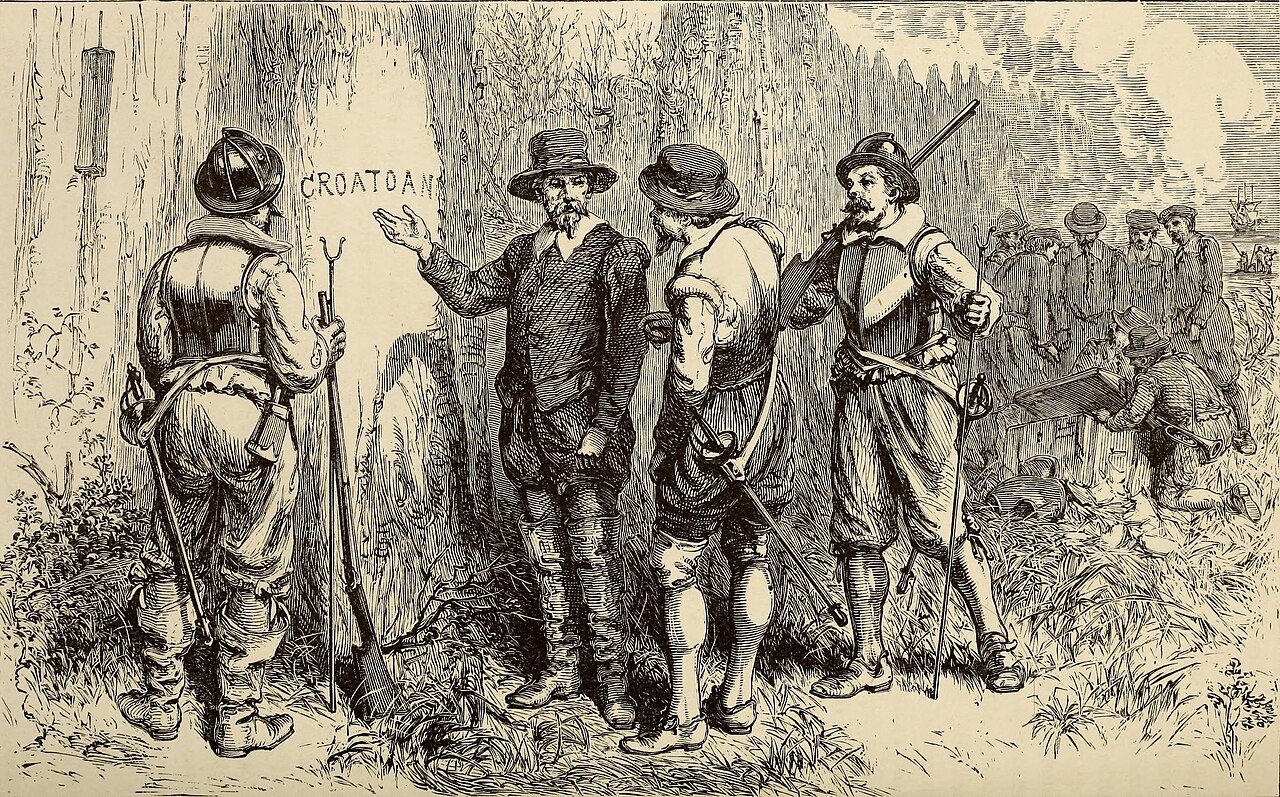
On 18 August 1590, his granddaughter’s third birthday, White landed on Roanoke. Seven men, including a captain, drowned when a boat capsized during the landing. The colonists were gone. The houses had been taken down and the site enclosed by a high, fort-like palisade. White found the letters “CRO” carved on a tree and “CROATOAN” on a post of the palisade. Before he left, he and the colonists had agreed that they would carve the name of the place they had gone to, with a cross above it if they were in distress. There was no cross. White took it as “a certaine token of their safe being at Croatoan, which is the place where Manteo was borne”. He also recalled that when he left, the colonists had been preparing to move “50 miles into the maine”. A storm prevented him from reaching Croatoan, and he returned to England. He died around 1606.
The theories
They joined the Croatoan on Hatteras Island
Supporters say: the colonists did what the carving said and went to Croatoan, now Hatteras Island, where they were absorbed into the Native community. In 1701 the explorer John Lawson was told by the Hatteras people that several of their ancestors were white, and he noted that grey eyes were common among them. Since 2013 the archaeologist Mark Horton has led digs on Hatteras, sponsored by the Croatoan Archaeological Society, finding English objects such as a rapier hilt, a gun barrel and a writing slate among Native artefacts. In 2024 and 2025 his team reported finding hammerscale, the flakes of iron produced by a blacksmith, in a layer dated to the colony’s era. Scott Dawson, who leads the society, argues that the colony was never lost at all.
Doubters say: many of the English objects lay among material from half a century or more later, and Horton has admitted that this is “deeply problematic”. They could have come through trade. The archaeologist Charles Ewen wants to see a forge hearth before accepting the hammerscale, and as of June 2025 the finding had not been published in a peer-reviewed journal. The National Park Service notes that no human remains, graves, buildings or village sites have been definitely linked to the colony.
They moved inland
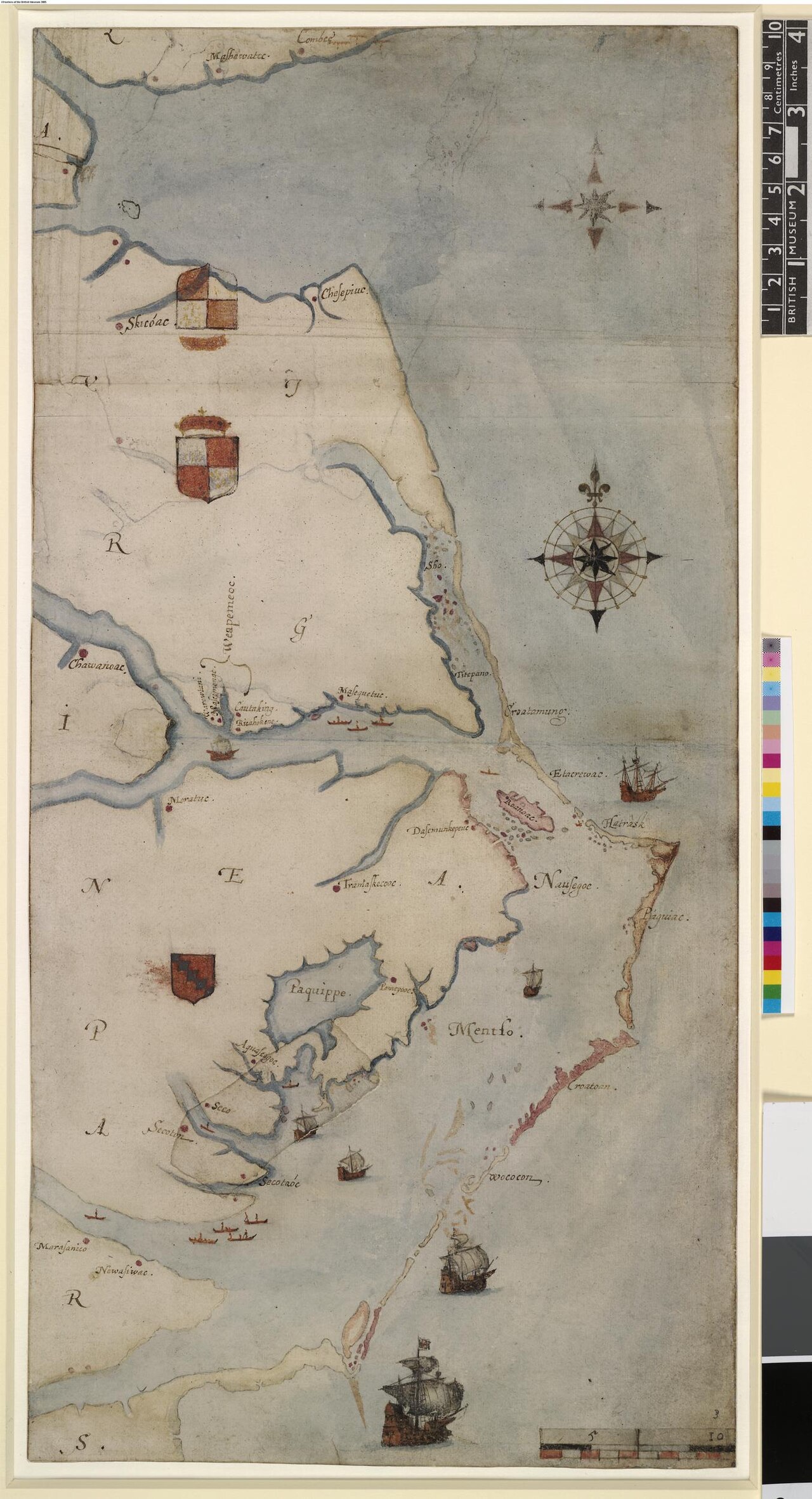
Supporters say: the colonists went “50 miles into the maine”, as White recalled. In 2012 curators at the British Museum examined White’s watercolour map of the region and found a symbol for a fort hidden under a patch, at the head of Albemarle Sound, about 50 miles west of Roanoke. The First Colony Foundation began digging nearby, at a place it called Site X, and in 2020 reported English and other European pottery at a second spot, Site Y, as “compelling evidence” that colonists lived there. In June 2026 the foundation declared “The Lost Colony is Found!”, arguing that the two sites were part of a settlement of scattered farms along the Chowan River.
Doubters say: no fort has been found, and the National Park Service says the artefacts there have not been definitely linked to the colony. Ewen has said the team is “looking to prove rather than seeking to disprove their theory”. The 2026 claim is the foundation’s own; no independent review of it was found.
Horton has suggested that the colonists may have split up, so both camps could be partly right.
They were killed
Supporters say: after the English founded Jamestown, they heard reports about the Roanoke colonists. William Strachey, the secretary of the Jamestown colony, wrote around 1612 that the colonists had been slaughtered on the orders of the powerful chief Powhatan. He also wrote that seven survivors, four men, two boys and a young girl, had been kept alive elsewhere to beat copper.
Doubters say: historians disagree over whether these rumours were true or were spread to frighten the English. No archaeological evidence of the colony has been found in the Chesapeake area.
Other explanations
The Spanish searched for the colony in 1588 but found no English settlers, and White saw no signs of a Spanish attack. The National Park Service notes that the buildings had been taken down rather than destroyed, which argues against a hurricane. Drought struck the region from 1587 and some colonists probably died of hunger or disease, but White found no graves.

Myths and forgeries
In 1937 a stone was found carrying what claimed to be a message from Eleanor Dare. Dozens more “Dare Stones” followed. All but the first are generally regarded as forgeries, and the first is still debated. In the late 19th century Virginia Dare also became a symbol of white supremacy in the Jim Crow South.
What is still argued about
- Where most of the colonists went, and whether they split up.
- Whether the finds on Hatteras and the mainland came from the colonists or from later trade.
DNA research has so far been limited by the lack of any DNA from known colonists to compare with. No poll appears to have asked what people think happened.

Sources
- Avalon Project, Yale Law School, “Charter to Sir Walter Raleigh: 1584”
- National Park Service, Fort Raleigh, “1587: The Lost Colony”
- National Park Service, Fort Raleigh, “1590 Rescue Voyage”
- National Park Service, Fort Raleigh, “Major Theories of the Lost Colony”
- John White, account of the 1590 voyage, from Hakluyt’s Principal Navigations (1600)
- National Geographic, “It Was America’s First English Colony. Then It Was Gone.” (2018)
- National Geographic, “Newfound survivor camp may explain fate of the famed Lost Colony of Roanoke” (2020)
- Live Science, “‘Lost Colony’ of Roanoke may have assimilated into Indigenous society, archaeologist claims — but not everyone is convinced” (2025)
- WHRO, “New artifacts on Hatteras point to the real fate of the Lost Colony” (2025)
- First Colony Foundation, “The Lost Colony is Found! How We Did It.” (2026)
- First Colony Foundation, “Scientific Tests Confirm FCF Archaeology Discovery” (2024)
- First Colony Foundation, “Roanoke and Croatan Tribal Movement” (2024)
- William Strachey, The Historie of Travaile into Virginia Britannia (Hakluyt Society, 1849), Internet Archive
- Encyclopedia Virginia, “First Anglo-Powhatan War (1609–1614)”
- North Carolina Department of Natural and Cultural Resources, “Mystery of the Dare Stones” (2014)