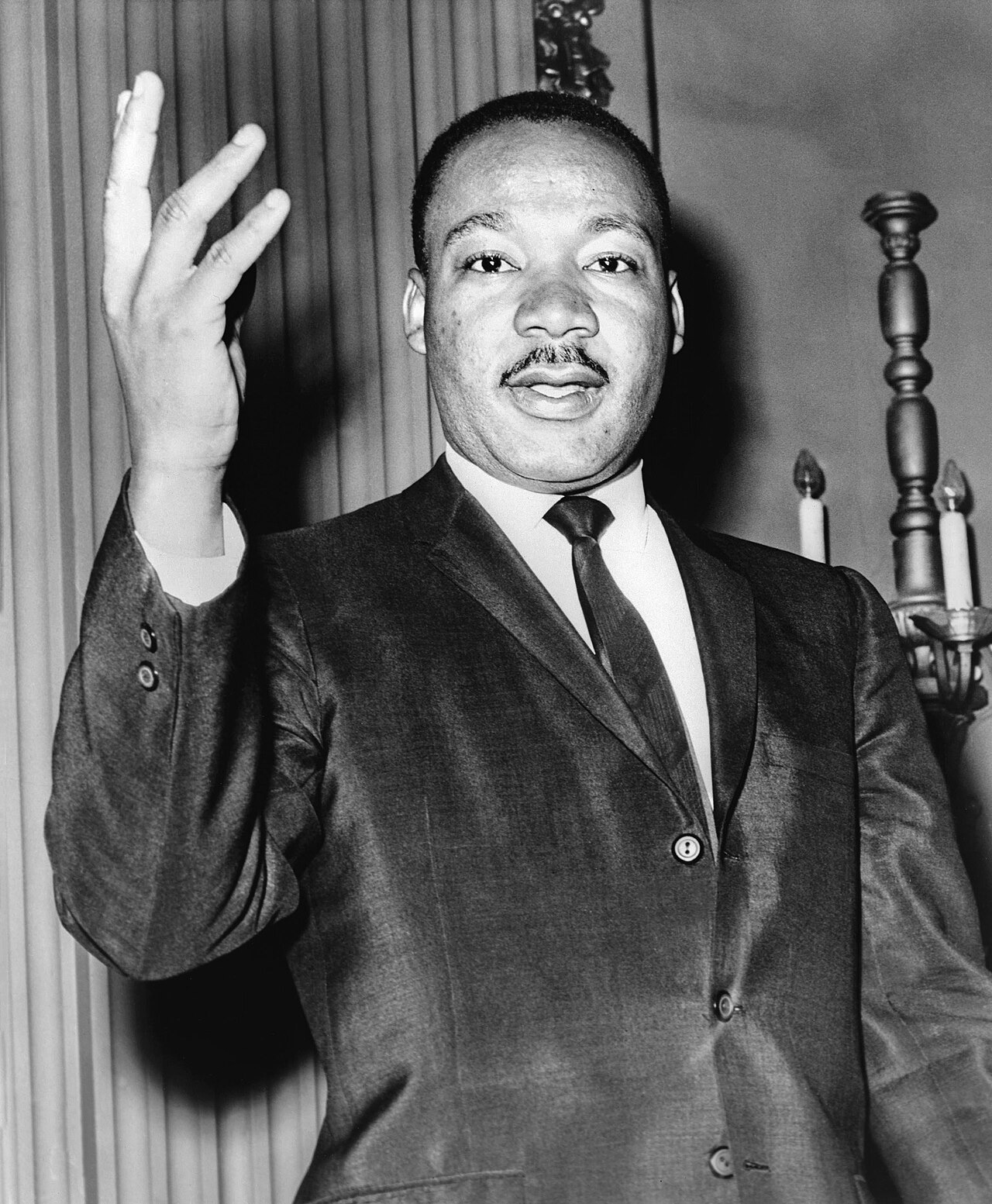

The short version
King was killed by a single rifle shot as he stood on the balcony of the Lorraine Motel. The rifle, with James Earl Ray’s fingerprints on it, was found dropped nearby. Ray, an escaped convict, fled to Canada and then to Britain, where he was arrested two months later. In 1969 he pleaded guilty and was sentenced to 99 years in prison. Three days later he took back his plea, and for the rest of his life he said he had been framed by a man he knew only as “Raoul”. In 1979 a committee of the US House of Representatives concluded that Ray fired the shot, but that he was likely part of a conspiracy, and that no government agency was involved. King’s family came to believe Ray was innocent. In 1999 a civil jury, in a largely uncontested case, found that a conspiracy had taken place. A Justice Department investigation in 2000 found no reliable evidence for that verdict’s claims.
What happened
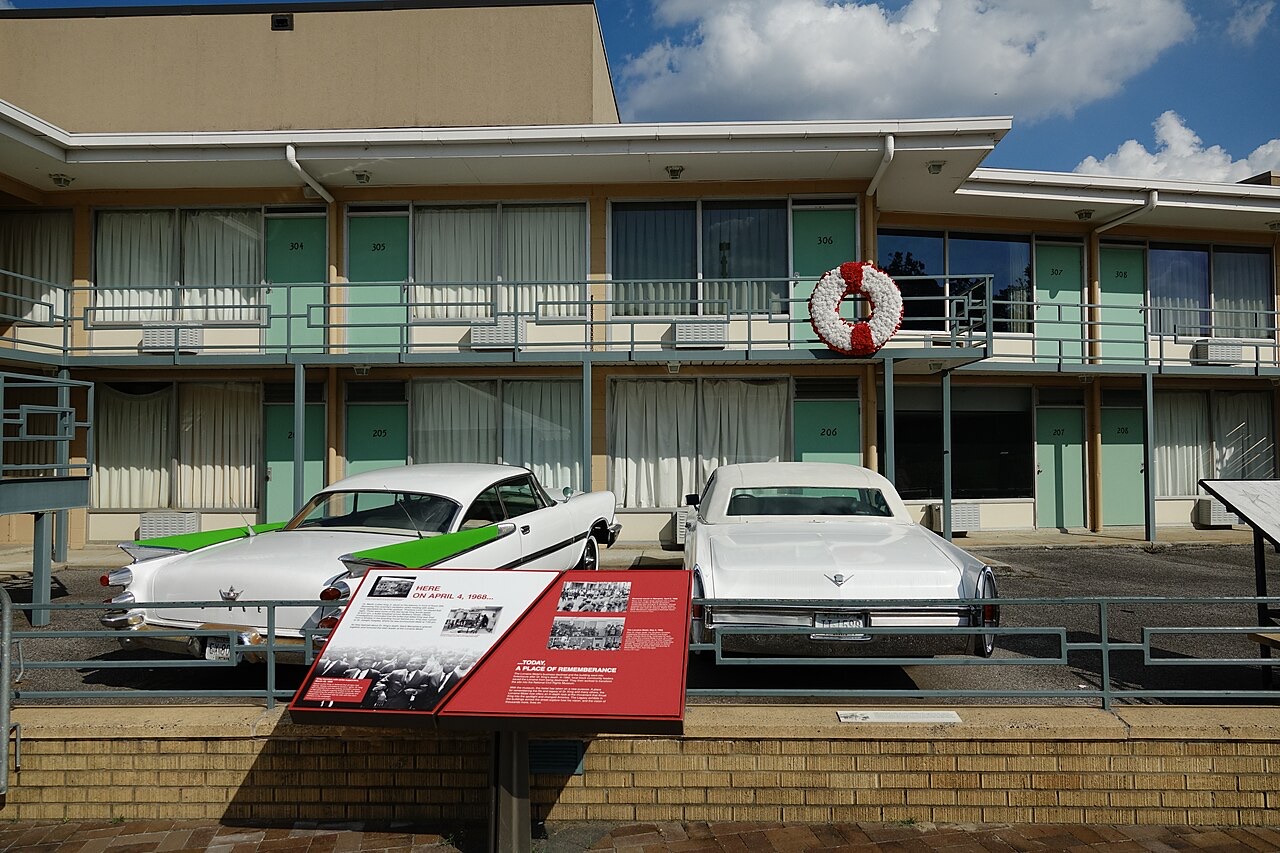
King had come to Memphis to support striking sanitation workers. At 6.01 pm on 4 April 1968, he was shot as he stood outside room 306 of the Lorraine Motel. He died at St. Joseph Hospital at 7.05 pm. The killing set off riots in more than 100 American cities and one of the largest manhunts in the country’s history.
Investigators concluded that the shot came from the bathroom window at the rear of a rooming house overlooking the motel. Minutes after the shooting, police found a bundle dropped on the pavement outside a shop next door. It held a rifle with a spent cartridge, binoculars, a radio and other items. Ray’s fingerprints were on the rifle, the scope and the binoculars.
The man who was convicted
Ray, 40, was a convicted armed robber who had escaped from the Missouri State Penitentiary in 1967. Under false names he had bought the rifle in Birmingham, Alabama, and rented a room in the rooming house. After the shooting he drove to Atlanta, abandoned his car and fled to Canada. On 8 June 1968 he was arrested at London’s Heathrow Airport with a Canadian passport in a false name and a loaded revolver. He later said he had been hoping to reach Rhodesia.
On 10 March 1969 Ray pleaded guilty and was sentenced to 99 years, avoiding a possible death sentence. As part of the plea he agreed that he had bought the rifle and shot King from the bathroom window. Three days later he wrote to the judge withdrawing his confession and asking for a trial. The judge died before acting on it. Courts upheld the plea eight times. Ray died in 1998, aged 70.
The official inquiries
The House Select Committee, 1979. The committee concluded that “James Earl Ray fired one shot at Dr. Martin Luther King, Jr. The shot killed Dr. King.” It found that his story of “Raoul” was “not worthy of belief”. But it also found “a likelihood” that Ray killed King “as a result of a conspiracy”. It believed his main motive was money. It found that two St. Louis men, both dead by the time of the inquiry, had offered a bounty of $50,000 for King’s murder in 1966 or 1967, and that word of the offer had likely reached Ray, though there was no direct evidence that he took it up or was paid. It found no involvement by any federal, state or local government agency.
The FBI. The committee sharply criticised the FBI. Under its secret COINTELPRO programme, the Bureau had for years watched King and tried to discredit him. In 1964 it anonymously sent him a recording and a letter that his staff read as urging him to kill himself. The committee said the FBI had “grossly abused and exceeded its legal authority”, and that the Justice Department and FBI had failed to investigate the possibility of a conspiracy adequately.
The King family and the 1999 trial
King’s widow, Coretta Scott King, said soon after the plea that “many fingers” had helped pull the trigger. In 1997 the family backed Ray’s request for a trial, and his son Dexter King met Ray in a Tennessee prison hospital. “Did you kill my father?” he asked. “No, no, I didn’t. No,” Ray said. When Ray added, “I had nothing to do with shooting your father,” Dexter King replied, “I believe you.”
In 1993 Loyd Jowers, who had owned a grill beneath the rooming house, told ABC television that he had been part of a plot to kill King and that Ray had not fired the shot. The King family sued him for wrongful death, represented by William Pepper, who had earlier been Ray’s lawyer. Pepper told the jury that the Mafia and agents of the federal government had been involved. On 8 December 1999 the jury found that Jowers and “others, including government agencies” had taken part in a conspiracy, and awarded the family $100.
The Justice Department noted that the verdict was one “offered by the parties”. Jowers did not testify, and his own lawyer told the jury it could reasonably conclude there had been a conspiracy. Jowers’ many contradictory accounts, and evidence that undermined the case, were not put before the jury. Even a writer sympathetic to the verdict reported that critics compared the trial to a wrestling match in which the defence put up only token resistance.
The Justice Department, 2000. Investigating the claims, the department found that Jowers had contradicted his own accounts and had never made his conspiracy claims under oath. It concluded that there was “no reliable evidence” for the conspiracy described at the trial, and “nothing to disturb the 1969 judicial determination that James Earl Ray murdered Dr. King”. It added that “questions and speculation may always surround the assassination”. King’s son Martin Luther King III replied that Ray “was not the triggerman”.

The arguments, point by point
The guilty plea
Those who doubt it say: Ray recanted within three days. According to the writer James W. Douglass, his lawyer had threatened to throw the case if it went to trial, and Ray answered the judge’s question about his guilt with a qualified “Yes, legally, yes.”
The response: the House committee concluded that Ray pleaded guilty knowingly, intelligently and voluntarily.
The rifle
Those who doubt it say: firearms tests never proved that the bullet came from the rifle found in the street.
The response: this is true. Tests could not show either way whether the fatal bullet was fired from that rifle. The rifle had been bought by Ray and carried his fingerprints.
Raoul
Those who doubt it say: Ray was steered to Memphis and set up by a man called Raoul.
The response: the House committee found Ray’s descriptions of Raoul inconsistent, and noted that Raoul’s fingerprints were not on the rifle that Ray said Raoul had handled. The Justice Department found that several people had been wrongly identified as Raoul over the years, and no reliable evidence that any Raoul took part.
The money and the getaway
Those who doubt it say: a small-time criminal could not have planned the killing, financed months on the run and obtained a false passport on his own.
The response: the House committee estimated that Ray spent about $9,000 while on the run, and judged that it most likely came from a bank robbery in his home town of Alton, Illinois, in 1967. That robbery was never solved. Even the committee thought he probably had help. Whose help remains unknown, and no one else was ever charged.
What is still argued about
- Who, if anyone, helped Ray.
- Where his money came from.
- Whether the 1999 verdict or the 2000 Justice Department report should carry more weight.
In 2025 the US National Archives released more than 230,000 pages of records on the assassination. King’s children said the files should be read in context and repeated that Ray had been set up. In a CBS News poll in 1998, only one in ten Americans thought Ray alone was responsible.
Sources
- National Archives, House Select Committee on Assassinations, “Summary of Findings” (1979)
- National Archives, House Select Committee on Assassinations, “Findings on MLK Assassination” (1979)
- National Archives, House Select Committee on Assassinations, “Findings on Martin Luther King, Jr. Assassination”, part 2 (1979)
- US Department of Justice, “Overview of Investigation of Allegations Regarding the Assassination of Dr. Martin Luther King, Jr.” (2000)
- US Department of Justice, “VII. King v. Jowers Conspiracy Allegations” (2000)
- CBS News, “Gov’t: No Conspiracy In MLK Killing” (2000)
- CBS News, “MLK’s Family Feels Vindicated” (1999)
- CBS News, “James Earl Ray Dead At 70” (1998)
- CBS News, “James Earl Ray: Timeline” (1998)
- The Spokesman-Review (AP), “Ray: ‘I Had Nothing To Do With Shooting Your Father’” (1997)
- ABA Journal, “June 8, 1968: James Earl Ray is captured” (2016)
- HISTORY.com, “James Earl Ray, suspect in Martin Luther King Jr. assassination, is arrested”
- Martin Luther King, Jr. Research and Education Institute, Stanford University, “Federal Bureau of Investigation (FBI)”
- James W. Douglass, “The King assassination: After three decades, another verdict”, The Christian Century (2000)
- Douglas Valentine, “Who Killed Martin Luther King?”, Facing South (2000)
- National Archives, “National Archives Works With Federal Partners to Release more than 230,000 Pages of MLK Assassination Records” (2025)
- NPR, “Trump administration releases trove of files on Martin Luther King Jr. assassination” (2025)
- CBS News, “King Assassination Still Puzzling” (1998)
- Voice of America, “King Conspiracy” (1999), mirror