
The short version
The phantom time hypothesis says that about 300 years were added to the calendar in the Middle Ages, and that the period from AD 614 to 911 never took place. If that were true, Charlemagne would be an invented figure, and today’s date would be about 300 years too high. The idea was first put forward in 1991 by the German writer Heribert Illig and developed with Hans-Ulrich Niemitz, a professor of the history of technology. Its supporters point to a calendar puzzle, to the many forged documents of the Middle Ages and to gaps in the archaeological record. Historians and astronomers answer that eclipses, tree rings, coins and the histories of the Islamic world and China all fit the conventional dates.
Who proposed it
Heribert Illig is a writer and publisher who holds a doctorate in German studies. He first set out the idea in articles in 1991, then in a book asking whether Charlemagne ever lived in 1994, and in Das erfundene Mittelalter (“The Invented Middle Ages”) in 1996. His collaborator Niemitz summed it up in a paper first written in 1995: “Between Antiquity (1 AD) and the Renaissance (1500 AD) historians count approximately 300 years too many in their chronology.”
Asked in 2014 whether history textbooks should therefore be redated, Illig answered that this would be absurd.
Who is supposed to have done it
In the usual version, the Holy Roman Emperor Otto III wanted to reign in the year 1000, a date of great religious meaning, and fixed the calendar to suit himself with the help of the scholar Gerbert of Aurillac, who became Pope Sylvester II. “Otto III didn’t live accidentally around the year 1000 AD; he himself had defined this date!” Niemitz wrote. Chroniclers then had to fill the gap with invented history, including the hero Charlemagne. The Byzantine emperor Constantine VII is said to have rewritten the history of his own empire to match.
Niemitz himself allowed that it may not have been deliberate. The men involved, he wrote, may have defined the year 1000 “perhaps unaware of their error and without intending to falsify”, and he rejected the idea of a secret society as “far too simple”.
The arguments, point by point
The calendar
Supporters say: Julius Caesar’s calendar, introduced in 45 BC, ran slightly too long and slowly drifted against the sun. By 1582 it should have drifted by 13 days. Yet Pope Gregory XIII’s reform that year removed only 10. “If 16 centuries had passed since Caesar’s introduction of his calendar, the Julian calendar in Gregory’s time would have been out of sync with the astronomical situation by 13 days, not 10,” Niemitz wrote.
The response: the reform was never meant to return to Caesar’s time. The papal commission decided in 1580 to restore the spring equinox to where it fell at the time of the Council of Nicaea in AD 325, whose rules were used for dating Easter. Ten days of drift had built up since then. A rival proposal at the time would have gone back to Caesar’s date by removing 14 days, and was rejected. Niemitz’s own sum, 1582 minus 1,257 years, lands on 325.
Forgeries
Supporters say: medieval charters were forged on a huge scale. In 1986 the Monumenta Germaniae Historica, which publishes medieval German sources, devoted a four-day international congress in Munich to the subject. Niemitz told a newspaper in 1995 that almost all written records of the Middle Ages were forged.
The response: historians agree that forgery was common, which is why the congress was held. The scholar whom Niemitz quotes on forgery, the institute’s president Horst Fuhrmann, made a narrower point about how forgeries came to be accepted over time.
Gaps in the record
Supporters say: the years from 600 to 900 are strangely empty. Niemitz pointed to gaps in building in Constantinople, in mosaic art and in excavations in Frankfurt.
The response: the evidence is thin but not absent. Coins are one example of what does survive. Charlemagne reformed the coinage in 793, and hoards and single finds show a unified currency across his lands, struck at dozens of mints.
The chapel at Aachen
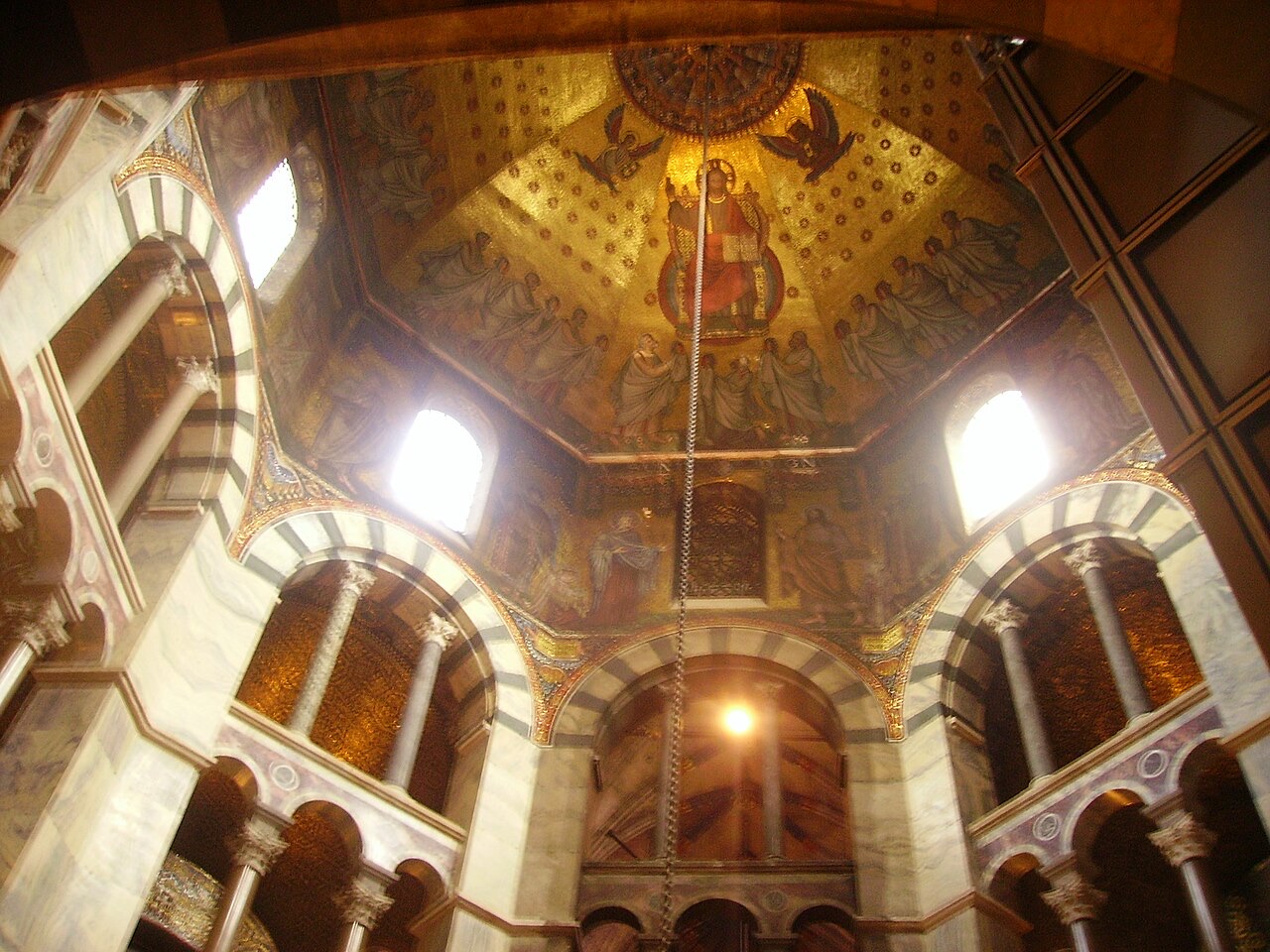
Supporters say: Charlemagne’s chapel at Aachen, dated to around 800, looks about 200 years too advanced for its time.
The response: in 2000 a team led by the Cologne building historian Sven Schütte reported that the oak in the throne at Aachen was felled during Charlemagne’s lifetime, probably shortly before his coronation in 800.
The sky
The response: astronomers can calculate past eclipses precisely. If 297 years were missing, eclipses recorded before 614 would not fall on the dates calculated for them. A total eclipse that NASA computes for 30 April 59 matches one recorded by the Roman writer Pliny. Halley’s Comet came closer to Earth in 837 than at any other recorded return. That year falls inside the supposed phantom period, and the comet is said to have frightened the Frankish emperor Louis the Pious into penance. The astronomer Dieter Herrmann in 1999, and Franz Krojer in a long book in 2003, answered Illig with arguments from astronomy.
Tree rings
Supporters say: tree-ring dating has few samples from these centuries, and radiocarbon dating depends on tree rings, so neither can be trusted for this period.
The response: the Hohenheim chronology of oak and pine from central Europe now runs without a break back more than 12,000 years, and it is the backbone of radiocarbon calibration for the region.
The rest of the world
The response: the phantom centuries would have to be missing everywhere, not only in Europe. Those years cover the rise of Islam, from Muhammad’s emigration to Medina in 622 to the early conquests, and almost the whole of China’s Tang dynasty, from 618 to 907. Niemitz accepted that his theory must apply to all of Eurasian and African history, and argued that the caliph Harun al-Rashid was an invention.
What scholars say
In 1997 the German journal Ethik und Sozialwissenschaften printed Illig’s case and published replies from historians including Gerd Althoff and Michael Borgolte, followed by Illig’s answer. The Oxford historian of chronology Philipp Nothaft writes that attempts like Illig’s have been made almost entirely from the fringes of serious scholarship.
A different theory
The Russian mathematician Anatoly Fomenko developed a far more radical “New Chronology”, which folds the whole of ancient history into the Middle Ages. It is separate from Illig’s idea, which leaves antiquity in place and only moves it closer to us.

What is true in the premise
- Medieval forgery was real and widespread.
- Written sources for the early Middle Ages are thin, and many survive only in later copies.
- The Julian calendar had drifted about 13 days since Caesar, and the 1582 correction removed only 10. The disagreement is about why.
- Scientific dates do get revised. The Aachen throne was once dated to 936, before being re-dated to the time of Charlemagne.
Online
Since about 2020 the idea has spread as a joke on YouTube, Reddit and TikTok, usually in the form “it is really the year 17-something”. A 2023 Reddit post about it drew more than 28,000 upvotes in four days. No opinion poll appears to have asked whether people believe it.
Sources
- Hans-Ulrich Niemitz, “Did the Early Middle Ages Really Exist?” (1995, revised 1997 and 2000)
- Deutsche Digitale Bibliothek, catalogue record for “Das erfundene Mittelalter” (1996)
- Abendzeitung München, “Karl der Grosse hat nie gelebt!” (2014)
- taz, “300 Jahre erstunken und erlogen” (1995)
- Discover Magazine, “What Is the Truth Behind the Controversial Phantom Time Hypothesis?” (2023)
- Mental Floss, “The Bizarre (and Blatantly False) Conspiracy Theory That Says the Middle Ages Never Happened” (2023)
- Catholic Encyclopedia, “Aloisius Lilius” (1910)
- Skeptoid, “The Phantom Time Hypothesis” (2012)
- timeanddate.com, “Julian to Gregorian Calendar: How We Lost 10 Days”
- NASA, “Five Millennium Catalog of Solar Eclipses: 0001 to 0100”
- Brian Koberlein, “Phantom Time” (2016)
- NASA Science, “1P/Halley”
- Astronomy, “Halley’s Comet through the ages” (2026)
- Dieter B. Herrmann, “Gab es eine Phantomzeit in unserer Chronologie?”, Acta Historica Astronomiae (1999)
- Perlentaucher, Franz Krojer, “Die Präzision der Präzession” (2003)
- Friedrich and others, “The 12,460-Year Hohenheim Oak and Pine Tree-Ring Chronology from Central Europe”, Radiocarbon (2004)
- Der Tagesspiegel, “Karl der Grosse: Der bisher nur mutmassliche Thron ist echt” (2000)
- Simon Coupland, “The Carolingians and Their Coinage”, Spink Insider (2025)
- History.com, “Muhammad completes Hegira”
- Smithsonian National Museum of Asian Art, “Tang dynasty (618-907)”
- University of Paderborn, Ethik und Sozialwissenschaften, volume 8 (1997), contents
- C. Philipp E. Nothaft, “Chronology’s Forgotten Medieval Pioneers”, JHI Blog (2016)
- Know Your Meme, “Phantom Time Hypothesis”