
The short version
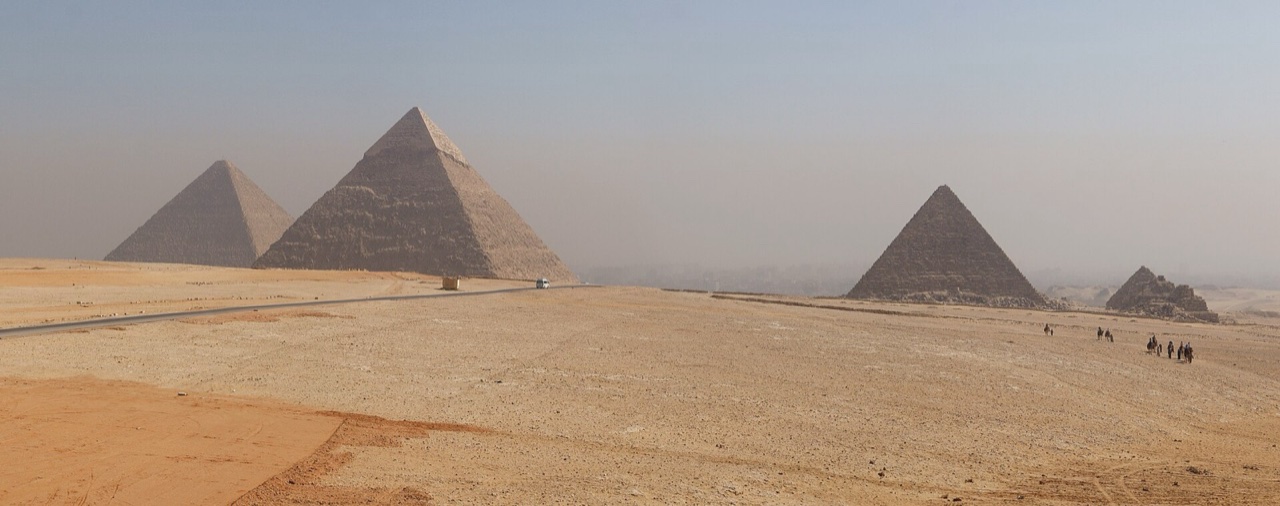
The Great Pyramid of Giza was built for the pharaoh Khufu around 2560 BC. It stood about 146 metres tall and contains roughly 2.3 million blocks of stone. The “ancient astronaut” theory holds that such a thing was beyond the people of the time, and that visitors from another world, or survivors of a lost advanced civilisation, supplied the knowledge or the labour. Egyptologists say the evidence for who built it and how is unusually rich.
Where the idea came from
In 1968 the Swiss author Erich von Däniken published Chariots of the Gods?, which argued that ancient monuments and myths around the world record visits by extraterrestrials. It sold tens of millions of copies. The long-running television series Ancient Aliens, which began in 2009, brought the idea to a new audience.
A related school of thought, associated with writers such as Graham Hancock, replaces the aliens with a forgotten human civilisation from the Ice Age.
Versions of the theory
Built by visitors. Extraterrestrials constructed the pyramids themselves.
Built with borrowed technology. Egyptians did the work using tools or techniques given to them, such as anti-gravity devices or methods of softening stone.
Inherited. The pyramids are far older than believed and were built by a lost civilisation. The pharaohs only repaired and claimed them.
Not tombs. The Great Pyramid was a power plant, a beacon or a machine.
The arguments, point by point
The precision
Believers say: the Great Pyramid is aligned to true north within a small fraction of a degree, its base is almost perfectly level, and its sides are nearly equal.
The response: Egyptian surveyors could find north by watching stars rise and set, and could level a site by cutting channels and filling them with water. Earlier pyramids are less accurate, and the improvement can be followed from one to the next.
The weight of the stones
Believers say: granite beams above the king’s chamber weigh up to 80 tonnes and came from quarries 800 kilometres away.
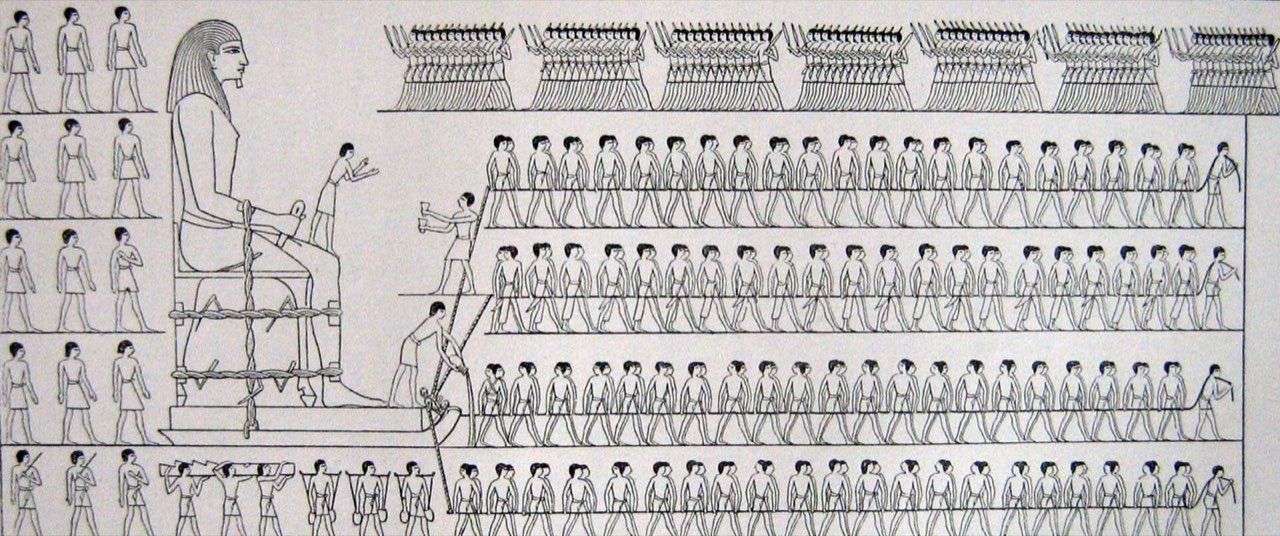
The response: most blocks weigh about two and a half tonnes. A tomb painting shows 172 men pulling a statue of nearly 60 tonnes on a sledge while a worker pours water on the sand in front. Experiments in 2014 confirmed that wetting sand roughly halves the force needed. In 2018 archaeologists found a steep ramp with post holes and stairways at an alabaster quarry from Khufu’s time, showing how blocks were hauled upward.
The time available
Believers say: placing 2.3 million blocks in twenty years means one every few minutes.
The response: with several thousand haulers working on many sides at once through daylight, the rate is demanding but possible. Estimates put the workforce at around 20,000 to 30,000 people, counting quarrymen, boat crews and bakers.
There are no records of how it was done
Believers say: the Egyptians wrote about everything and left no account of the building.
The response: in 2013 a French-led team found the oldest inscribed papyri known, at an ancient port on the Red Sea. Among them is the logbook of an official named Merer, who led a work crew. Published accounts put its size at between 40 and 200 men. The logbook records, day by day over several months, his team loading limestone at the quarries of Tura and ferrying it by boat along the Nile and canals to the building site at Giza, and names the king’s half-brother as the official in charge.
Pyramids appear around the world
Believers say: Egypt, Mexico and Asia all have pyramids, which suggests a shared teacher.
The response: a wide base and a narrow top is the stable way to build tall without steel. The Egyptian and Central American pyramids were built more than two thousand years apart, from different materials, for different purposes.
No mummy was found in the Great Pyramid
Believers say: so it was never a tomb.
The response: it was robbed in antiquity, like nearly every royal tomb in Egypt. It contains a stone sarcophagus and sits in a cemetery of the king’s relatives and officials.

What archaeologists have found
The learning curve. Egypt’s pyramids form a sequence. The first, built for Djoser about a century earlier, is a stack of steps. A later one partly collapsed. Another had its angle changed halfway up when cracks appeared, leaving it visibly bent. The smooth-sided form was reached by trial and error.
The workers’ town. South of the pyramids, excavations uncovered a planned settlement with dormitories, bakeries, breweries and vast quantities of cattle, sheep and fish bones. The builders were well fed.
The workers’ tombs. Nearby are the graves of labourers and overseers. Their skeletons show the wear of heavy work, along with healed fractures and even successful amputations, which means they received medical care. Their burial beside the king indicates they were respected employees and conscripted farmers. They were not slaves.
The graffiti. In sealed chambers above the king’s burial room, work gangs painted their names, such as “Friends of Khufu”, on blocks that were never meant to be seen.
The tools and quarries. Copper chisels, stone hammers, sledges, ropes and unfinished blocks survive, and the quarries beside the pyramids still show where stone was cut.
Recent claims
In March 2025, a group of Italian researchers announced that satellite radar had revealed enormous shafts and chambers extending hundreds of metres beneath the pyramid of Khafre. The story spread widely. Egyptian authorities and radar specialists rejected it, saying the technique cannot see that far into rock and that no such survey had been authorised. One widely shared image was generated by artificial intelligence. An earlier paper by members of the group using the same method was later retracted by the journal.


What is still argued about
- The exact arrangement of ramps used for the upper levels. Several designs have been proposed and none is proven.
- The purpose of narrow shafts and of a large empty space above the Grand Gallery, detected in 2017 using cosmic-ray particles.
- How long the whole project took and how the workforce was organised.
These are open questions about method. Who built the pyramids is not among them.
A point critics make
Archaeologists often observe that “aliens did it” is rarely said about European cathedrals. They argue that the theory underestimates ancient Africans, and that the real story of organisation, mathematics and labour is more impressive.
Sources
- National Geographic, “This ancient diary reveals how Egyptians built the Great Pyramid”
- Smithsonian Magazine, “The World’s Oldest Papyrus and What It Can Tell Us About the Great Pyramids”
- History Today, “Monumental Record”
- National Geographic, “Is there really a secret city under Egypt’s pyramids?” (2025)
- Al-Ahram Weekly, “Controversy over Pyramid claims” (April 2025)
- Newsweek, report on the retraction of the Great Pyramid radar study (2026)
- Archaeology Magazine, “Wet Sand May Have Helped Egyptians Move Pyramid Stones” (2014)
- Archaeology Magazine, “Ancient Ramp Uncovered in Egyptian Alabaster Quarry” (2018)
- Mark Lehner, The Complete Pyramids (1997)
- Pierre Tallet and Mark Lehner, The Red Sea Scrolls (2021)