
The short version
The archaeological evidence shows that Norse sailors from Greenland reached North America about five centuries before Christopher Columbus crossed the Atlantic in 1492. Their voyages were remembered in two Icelandic sagas, and in 1960 the remains of their camp were found at L’Anse aux Meadows in Newfoundland, Canada. In 2021 a study in Nature showed that wood was cut there with metal tools in the year 1021. It is still the only confirmed Norse site in the Americas. What remains open is where the saga’s Vinland was, how far south the Norse travelled, how long they stayed, and whether any other site or object is genuine.
What the sagas say
Two Icelandic sagas, the Saga of the Greenlanders and the Saga of Erik the Red, describe voyages west from Greenland. They were told aloud for generations and written down much later, around 1200 or after. They disagree in places: the first describes four separate expeditions, while the second merges them into one large journey.
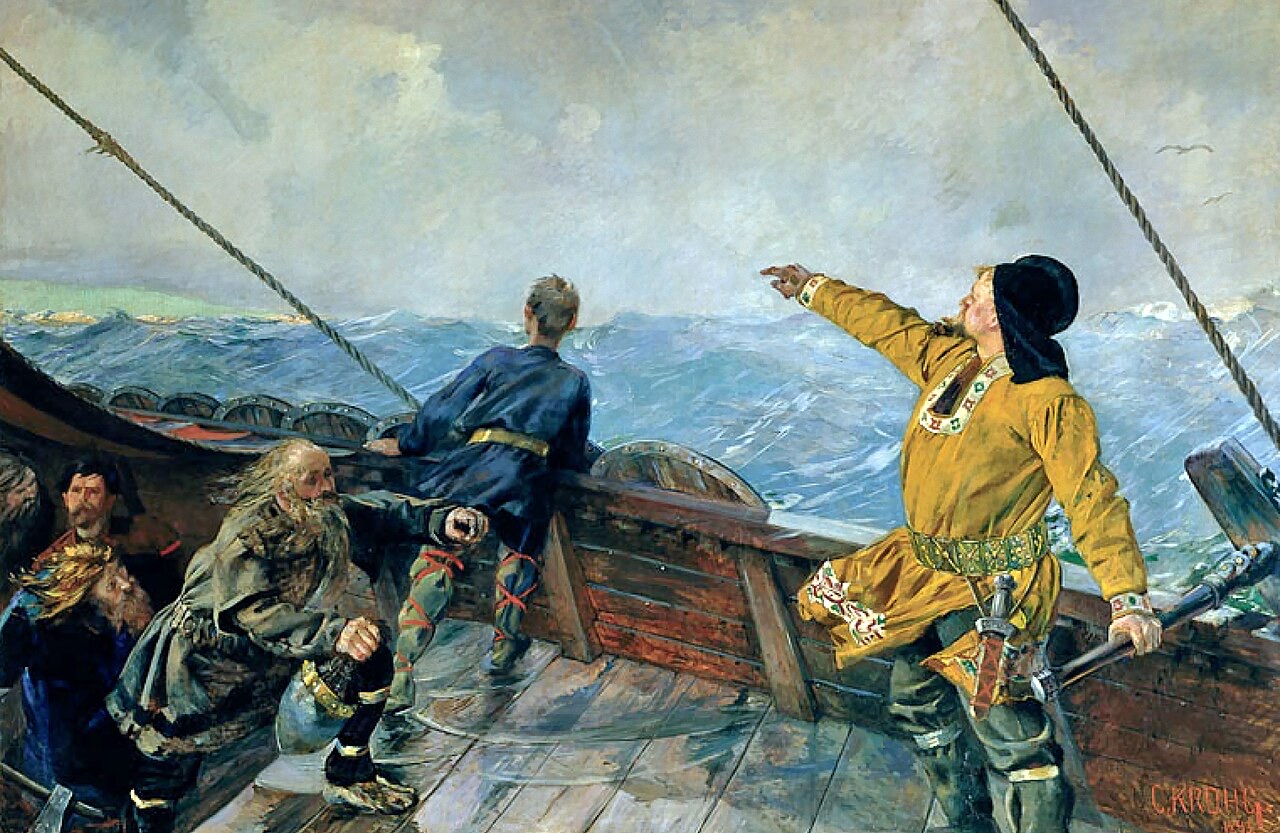
Bjarni Herjólfsson. According to the Saga of the Greenlanders, Bjarni was blown off course in 986 while sailing to Greenland and sighted three unknown lands without going ashore.
Leif Eriksson. Leif, son of Erik the Red, the founder of the Norse settlements in Greenland, later bought Bjarni’s ship and sailed the same way. He named three lands: Helluland (“Flagstone land”), Markland (“Woodland”) and Vinland (“Wineland”), where, in the saga, a member of his crew found wild grapes. Historians usually identify Helluland with Baffin Island and Markland with Labrador. Vinland is much harder to place.
Later voyages. Leif’s brother Thorvald died on an expedition. The Icelandic trader Thorfinn Karlsefni led a larger one, with ships, livestock and women as well as men, though the sagas give different numbers. A son, Snorri, was born to Karlsefni and his wife Gudrid during their stay. According to the sagas he was the first child of European descent known to have been born in the Americas. A last expedition led by Leif’s sister Freydís ended in killing.
Meeting the people already there. The Norse called the Indigenous people they met “Skrælings”, probably a derogatory name. They were possibly ancestors of the Mi’kmaq, Beothuk or Innu. The sagas describe trading, then fighting in which people on both sides were killed. On the way home the Norse captured two Indigenous boys. Outnumbered, the Norse went back to Greenland.
The site in Newfoundland
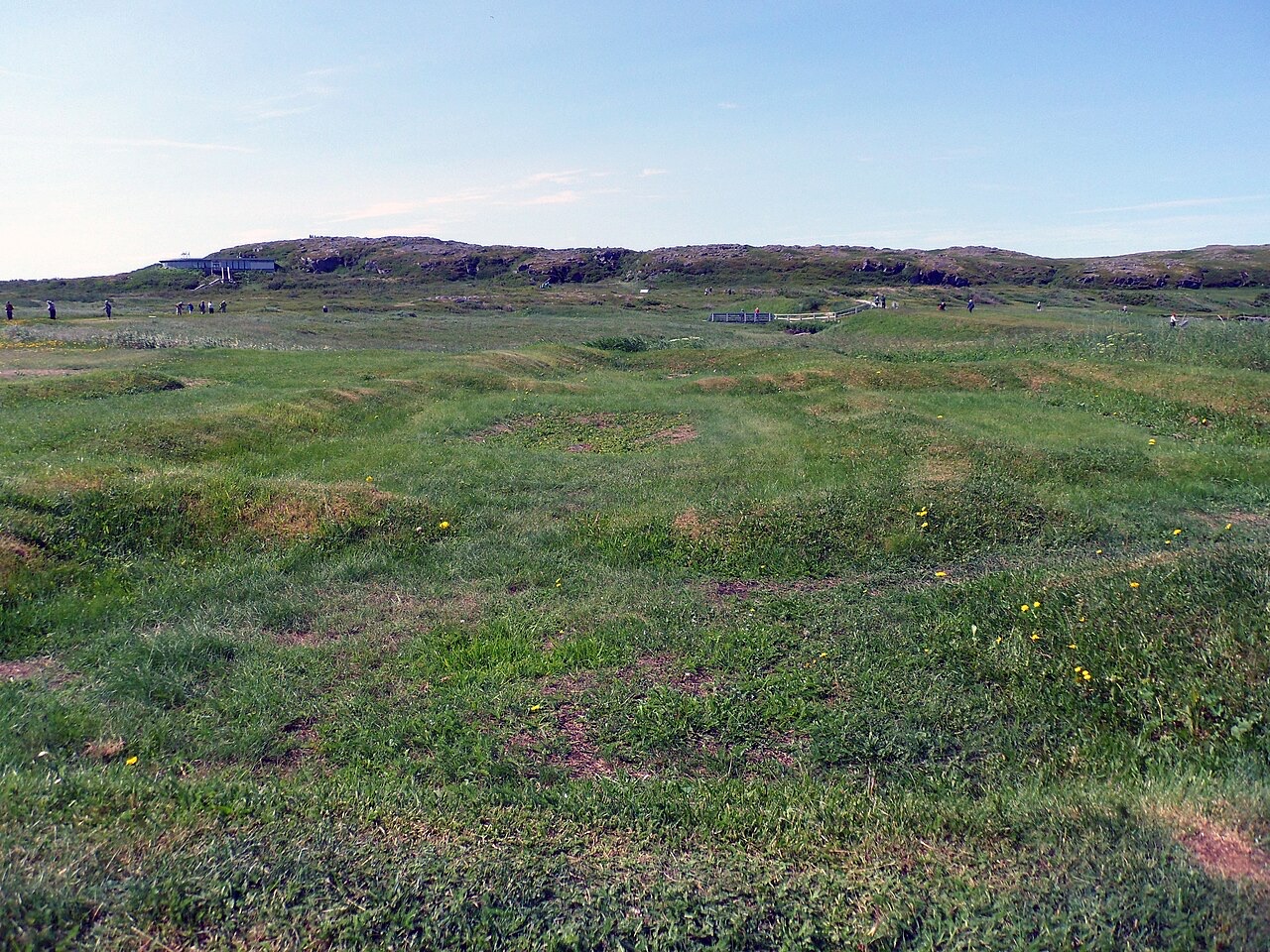
The discovery. In 1960 George Decker, who lived at L’Anse aux Meadows on the northern tip of Newfoundland, showed the Norwegian explorer Helge Ingstad a group of overgrown mounds. From 1961 to 1968 his wife, the archaeologist Anne Stine Ingstad, led excavations with an international team, and proved the site was Norse and dated to the 11th century. Parks Canada later dug there again.
What was found. The mounds were the walls of eight sod buildings of the kind used in Iceland and Greenland around the year 1000, enough to house perhaps 70 to 90 people. There was a small furnace where iron was made from bog ore, the first known iron smelting in the Americas, along with slag and iron boat rivets. Smaller finds included a bronze cloak pin, a stone oil lamp and a spindle whorl used for spinning thread, which shows that not all the Norse there were men.
The butternuts. Three butternuts and pieces of butternut wood were found in a bog at the site. Butternut trees do not grow north of eastern New Brunswick. Someone must have brought them from further south, from the region around the Gulf of St. Lawrence, where wild grapes also grow.
What it was for. The archaeologist Birgitta Wallace, who excavated there for Parks Canada, describes it as a base for exploring and gathering resources, not a colony. It was used for a short time, perhaps a few years to about a decade. Five Indigenous groups used the same spot at different times before the Norse, and one after them. The site has been a UNESCO World Heritage Site since 1978.
The year 1021
In 2021 a team led by Margot Kuitems used a known event to fix an exact year. In 993 a burst of cosmic radiation raised the amount of radiocarbon in the air, and the jump shows up in the tree ring for that year. Using that signal in wood from the site, they showed that three different trees were cut down in 1021, with metal tools that the Indigenous people of the area did not make at the time. The authors call it “the only secure calendar date for the presence of Europeans across the Atlantic before the voyages of Columbus”.
The date shows the Norse were there in 1021. It is not necessarily the year they first arrived.

Objects that do not hold up
The Kensington Runestone. In 1898 a Swedish immigrant farmer, Olof Ohman, said he had found a carved stone near Kensington, Minnesota. Its runes tell of Swedes and Norwegians there in 1362. Experts called it a fake in 1899, and most have agreed since, partly because the language does not match the 14th century. The Minnesota Historical Society says the most likely maker was Ohman, who never admitted a hoax.
The Vinland Map. Yale University announced in 1965 a supposedly 15th-century map showing an island of Vinland southwest of Greenland. In 2021 Yale announced that a titanium compound used in inks only from the 1920s runs through the map’s lines and text. “There is no reasonable doubt here,” Yale’s announcement said. The parchment itself is medieval.
The Maine Penny. A genuine Norwegian silver coin from the reign of King Olaf Kyrre, struck in the second half of the 11th century, was reported found in 1957 at a Native American site in Maine. Whether the find itself was genuine has been questioned. The Maine State Museum’s view is that the coin reached Maine through Indigenous trade networks, not on a Norse ship. No other Viking Age finds have been made there.
Point Rosee. In 2016 the archaeologist Sarah Parcak reported possible Norse remains in southwest Newfoundland, found on satellite images. Her team’s final report found no evidence of Norse presence or of any human activity there before the historic period.
Why Columbus still gets the credit
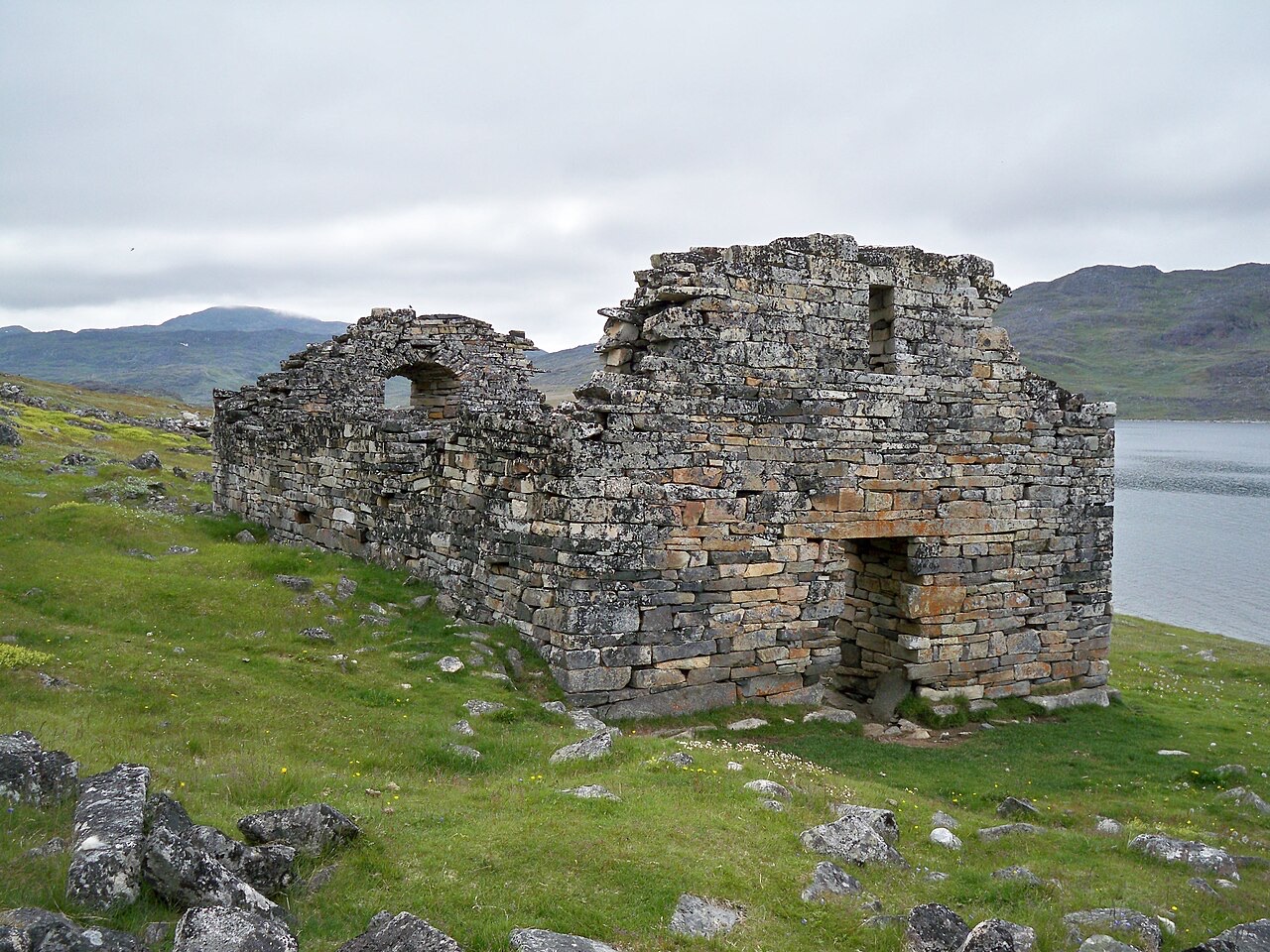
The Norse visits left no lasting colony and no lasting link with Europe. Norse Greenland itself faded away: the last written record is of a wedding at Hvalsey Church in 1408, and the settlements were empty by about 1450. Columbus’s voyages began lasting European colonisation. In a 2024 YouGov poll, 39 per cent of Americans said Leif Eriksson reached the Americas before 1492 and 52 per cent were not sure.

What is still argued about
- Where Vinland was. Most specialists think the Norse travelled into the Gulf of St. Lawrence and northern New Brunswick, and Wallace places the saga’s southern camp, Hóp, on the Miramichi River. Older scholars proposed places from Hudson Bay to Florida, most often around Cape Cod.
- How long and how often the Norse came. Some historians think there were many unrecorded voyages over the centuries that Greenland was settled.
- Which saga figure built the camp. Parks Canada says it could have been Leif, Karlsefni or another Norse captain.
Sources
- Kuitems and others, “Evidence for European presence in the Americas in AD 1021”, Nature (2021)
- Parks Canada, “L’Anse aux Meadows National Historic Site”
- Parks Canada, “Culture and history - L’Anse aux Meadows National Historic Site”
- Parks Canada, “Saga of Discovery”
- Birgitta Wallace, “L’Anse aux Meadows”, The Canadian Encyclopedia
- Birgitta Wallace, “Karlsefni”, The Canadian Encyclopedia
- Dictionary of Canadian Biography, “Leifr heppni Eiriksson”
- Dictionary of Canadian Biography, “Bjarni Herjólfsson”
- Dictionary of Canadian Biography, “Snorri Thorfinnsson”
- CBC News, “On the trail of Vikings: Latest search for Norse in North America” (2016)
- CBC News, “How an endangered tree may link Vikings to New Brunswick” (2019)
- Minnesota Historical Society, MNopedia, “Kensington Runestone”
- YaleNews, “Analysis unlocks secret of the Vinland Map - it’s a fake” (2021)
- Svein H. Gullbekk, “The Norse Penny Reconsidered”, Journal of the North Atlantic (2017)
- Live Science, “Did the Vikings reach Maine?” (2026)
- National Geographic, report on the Point Rosee excavation (2016)
- iNFOnews, “No Viking presence in southern Newfoundland after all, American researcher finds” (2018)
- National Geographic, “The mystery of the Norse Vikings who vanished from Greenland” (2026)
- Science News, “Vikings may have fled Greenland to escape rising seas” (2021)
- YouGov, “Has Leif Erikson come out of Christopher Columbus’ shadow?” (2024)